Why should children enjoy messy (also known as sensory) play? Well scientific research shows that the brain is stimulated through movement and the senses. To ensure the circuit of a child's brain reaches its full potential, then sensory experiences are vital. So we did get messy! We made salt dough together (messy, gooey!!!). And the children shaped the dough into little gingerbread men.

Showing posts with label Montessori Sensorial. Show all posts
Showing posts with label Montessori Sensorial. Show all posts
Wednesday, December 16, 2015
Monday, March 16, 2015
Making Bath Salts for Mother's day
Art and craft must be meaningful to the children and meaningful in term of learning. Each craft is usually related to the current theme or topic. This week, as we prepared for Mother's Day, I thought of making salt baths with the children. I gathered all the ingredients necessary for it : Epsom salts, sea salts, baking soda, food colouring and essential oils (orange mandarin).


Wednesday, February 8, 2012
Unispiring geometric solids? Not anymore!!
I must admit that our Geometric Solids have been rarely used in our classroom, probably because it didn't inspire the children. The children have been introduced to the names of each solids but this is not a popular activity. I had been thinking about extending the exercise but never gor around it until I finally got onto Montessori for Everyone and downloaded a set of matching cards to be used in conjunction with the geometric solids. The set of cards depicts each of the Geometric Solids with several corresponding photos for each shape. The photos represent objects in the child’s environment/community. I made a set of 10 labelled geometric solid cards to be placed under each solid and a set of 30 picture cards for sorting. I placed them all in a basket, right beside the geometric solids on our sensorial shelves. The child will be asked to first match the geometric solid cards to the solids. Then, he picks the set of picture cards and places each one of them under their corresponding solid.
 |
| Picture borrows from Montessori Albums |
The first thing I do is to bring a child to the sensorial shelves and tell him/her that I am going to show him/her how to work with a new piece of material.
- I use the work cycle to present the exercise
- At the start of the lesson, we first place the solids horizontally from left to right on the top of the mat. I then re-introduce the names of the solids. As I go over each name, I point at the name labelled on the cards.
- I introduce the matching Geometric Solid cards and show the child how to match them to the solids.
Once the child is successful with the first set of cards, I then invite her to sort the remaining picture cards underneath. Everytimethe child places a card underneath a solid card, I ask her/him why she/he does so, enticing her/him to think about the shape and its characteristics. Once child placed the tent under the rectangular prism and when asked why, he said: “well, it has a rectangle shape here and a triangle shape here. And I have slept in a tent before with my Mam and Dad, so I know”. This comment spurred a flow of other comments from the children who eagerly shared their own experience.


Once the exercise is completed, I show the child how she could turn the cards around and check for herself if her work was correct. Each card is colour-coded for control of error. I then show her how to tidy up the picture cards first from left to right, row by row. Then we pick up the labelled geometric cards from left to right. We place all the cards back in their basket. We then pick up all the solids from left to right and place them all in their basket. Both baskets are then returned to the sensorial shelves.

I have to admit, this is not a table top activity and I should have presented the exercise on the floor. There is always room for improvement!!! All in all though, I found this activity absolutely brilliant for several reasons:
- During one of my many presentations, many children gathered up around Millie ( 4 years old) and myself. I was surprised with the visual impact the cards created once they were all laid out with the Geometric Solids. In fact, throughout the lesson, several children in the classroom came to see what the "new work" was and I heard more remark, "Oooh, what's that? I want to do that!" It was heartening to see a new interest develop in the Geometric Solids sparked by this set.
- Children may make several observations about this work. This activity was brilliant to begin discussions. First of all, the children realised quickly that certain shapes are much more likely to occur in nature (ellipsoids) while others are much more likely to occur in human made construction (pyramids). And the ones made by men are much harder to find than the others. It was wonderful to see the children speculate as to why that is, and brainstorm about other examples of each of these types of solids.
- The children’s range of vocabulary as we revised the names of all the solids and compared them to their day-to-day usage. For instance, people commonly refer to any structure that starts broadly and ends narrowly as a pyramid (a child’s tower of blocks, for example).
- The children know to spot the differences between a square-based pyramid and a triangular pyramid. It got the children to look at the details of each shape more carefully by comparing and matching. So if you want to stimulates your children’s awareness of geometric shapes, this is the way to go!
- The activity introduces them to mathematical concepts (geometry)
- And believe it or not, but the whole exercise indirectly introduces children to art appreciation as they learn about the specific characteristics of each solid.
Ok... as I am studying like mad at the moment for my Montessori Degree, I decided to link this activity to theory. So, you may want to quit the reading of this post right here as it is going to get a bit "boring" for some of you!!! But believe me, it is a great practising exercise for me. So just bear with me!!
"Teachers in general are continually looking for ways to guide students’ understanding of mathematical concepts. Contemporary research has demonstrated that pre-schoolers need opportunities to explore their world and experience mathematics. There are 3 fundamental mathematical concepts that form the building blocks of mathematical and scientific knowledge: matching, classification, order & seriation. The development of these concepts allows the children to organize and categorize information so that when they start formal schooling, they begin to apply fundamental concepts by exploring ideas both in maths and science (Charlesworth and Lind, 1999). The constructivist paradigm based on Piaget’s (1955) theory of cognitive development has long provided a framework for educational practices in which children gain concepts trough involvement with the environment and construct their knowledge as they explore their surroundings. This means using manipulative materials that enable children to engage in active learning. Using pictures of objects that can be found in the children’s everyday life gives them the right experience in assessing the different characteristics of the solids and help the children to place them in their environment.
"Teachers in general are continually looking for ways to guide students’ understanding of mathematical concepts. Contemporary research has demonstrated that pre-schoolers need opportunities to explore their world and experience mathematics. There are 3 fundamental mathematical concepts that form the building blocks of mathematical and scientific knowledge: matching, classification, order & seriation. The development of these concepts allows the children to organize and categorize information so that when they start formal schooling, they begin to apply fundamental concepts by exploring ideas both in maths and science (Charlesworth and Lind, 1999). The constructivist paradigm based on Piaget’s (1955) theory of cognitive development has long provided a framework for educational practices in which children gain concepts trough involvement with the environment and construct their knowledge as they explore their surroundings. This means using manipulative materials that enable children to engage in active learning. Using pictures of objects that can be found in the children’s everyday life gives them the right experience in assessing the different characteristics of the solids and help the children to place them in their environment.
Also, having a print rich, or literacy rich environment is an important aspect of a child’s literacy education. According to one study, exposure to written language helps children develop a number of things including: awareness of print, phonemic awareness, letter naming, listening comprehension and eventually word reading. (Gunn, Simmons, & Kameenui, 1995, 3). Marie Clay (Teale & Sulzby, 1986) was the first person to introduce the term emergent literacy to describe the behaviors used by young children with books and printed words, even though the children could not actually read and write in the conventional sense. Mary Clay suggests that literacy development begins way before children start formal instruction in elementary school (Teale & Sulzby, 1986). Children have been found to learn about written language as they actively engage with adults in reading and writing situations; as they explore print on their own; and as they observe others around them engaged in literacy activities (Teale & Sulzby, 1986). For example, when hearing me say the word “ellipsoid” a few times and pointing at the printed word at the same time, the children are not just memorizing the word, but actually learning that printed words carry a meaning. And this is why labelling is very important. In a Montessori environment, we use lots of nomenclatures and 3 part-cards with words printed on the cards. Just like in this activity. Repetition will provide experience for the children and help them associate the printed word with its meaning or what it represents."
I hope I make sense!
Sunday, January 22, 2012
January Montessori work
I can't believe that the month of January is nearly coming to an end.. January always feels like a long Monday but we have been so busy this month that it flew buy!! Many children have been sick, unfortunately. So I hope everybody is now better and ready for more action!! For those who were out, here are a few of the activities we went through last week.
We have worked a lot on colour recognition with the younger kids in the classroom:
A little bit of work on getting new vocabulary and learning about animal habitats:

The children love working with the peg game I introduced on our shelves last week. This is a great way for them to become familiar with letters and it promotes letter recognition in a fun way:

Lots of work in our sensorial corner. I printed several pictures of work using the Brown Stairs and the Pink Tower, laminated the A4 sheet and hung it on our shelves besides the Pink Tower. We had been using both of these Montessori sensorial materials in a much more conventional way so far and introducing these little variations have proved very successfully.

And of course, the metal insets are still very popular. This is a brilliant exercise to teach children to write from left to right, top to bottom, and to improve their pincer grasp skills. A great pre-writing activity.

Last week, I showed them how they could make geometric figures on a big A4 page and starightaway, little fingers got to work. Amazing work here!


We have worked a lot on colour recognition with the younger kids in the classroom:
 |
| Grading shades of colours |
 |
| Matching jigsaw |
A little bit of work on getting new vocabulary and learning about animal habitats:


Lots of work in our sensorial corner. I printed several pictures of work using the Brown Stairs and the Pink Tower, laminated the A4 sheet and hung it on our shelves besides the Pink Tower. We had been using both of these Montessori sensorial materials in a much more conventional way so far and introducing these little variations have proved very successfully.

 |
| Some of their work as you can see are not exact but let's not burst their little bubbles!! They were so proud of what they had achieved. As they do it again, they will solve the difficulties themselves, working as a team. |
And of course, the metal insets are still very popular. This is a brilliant exercise to teach children to write from left to right, top to bottom, and to improve their pincer grasp skills. A great pre-writing activity.

Last week, I showed them how they could make geometric figures on a big A4 page and starightaway, little fingers got to work. Amazing work here!

A popular math material in my classroom is this Hanging Bead Stair. The child needs to hang the bead stairs in ascending order and correctly sequence the number tiles accordingly to the beads. Once they have mastered this exercise, we hang the beads in random order on the hooks and have the child match the number tiles accordingly. This is a variation we came up with last year but I haven't reached that stage yet with any of the children...But I will take pictures as soon as we have a winner!!!!


So this is a little overview of what went on in our classroom. Tomorrow, we are staring to talk about winter animals as partof our winter theme. So keep in touch to see what we came up with! And if you have any suggestions, please leave a comment!!
Sunday, January 8, 2012
Back to school!!
Well, vacation's over and it's back to work!! I spent 3 days at school getting all the Christmas stuff put away and getting out new activities. Below is a glimpse of some of what was new for the students:

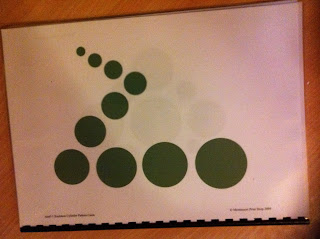


On the other side, I glued the word corresponding to the picture. Using wooden pegs, I wrote each letter of each picture on top of the peg.


First, I wanted to add a bit of spice to our knobless cylinders. The children love them and we have used them in any possible ways as taught by Maria Montessori. For those of you not familiar with the Montessori method, the knobless cylinders are four sets of wooden cylinders, each a different color that correspond to the cylinder blocks, are used in early childhood development to help children begin to understand the concept of dimension. So I went to Montessori Print Shop and purchased 2 set of knobless cylinders pattern cards. I printed some of them and bound them together. The children will now be able to make shapes with the different cards, mixing them and learning to appreciate variations of height and width within each patterns. . This will definitely encourage additional sorting and comparison drawing as well as making the building process more difficult. I think it is quite good. My little man was the first one to say so...


We have a moveable alphabet in our classroom. As we finish our study on the first Montessori set of letters (a,c,m and t), we will start using quite a lot to make up words phonetically. Until then, I wanted familiarise the children with all the letters of the alphabet. I could have used the moveable alphabet but I decided to create an exercise which should attract the children. I printed a few random pictures and glue them on one side of a coloured card.


On the other side, I glued the word corresponding to the picture. Using wooden pegs, I wrote each letter of each picture on top of the peg.

The idea is for the child to look at the picture, make the link betweent he picture and the word and then look for the corresponding letters. This a pre-reading activity but it also let the child practise his pincer grasp (essential for writing). So I am killing 2 birds with one stone!!
I have also added a few more seasonal activities:
- Icicle making: the children use all the beads, the white straw and the snowflakes to create their own icicle.


- A snowman grid game using a dice. 2 players. The first one to fill his/her grid is the winner.
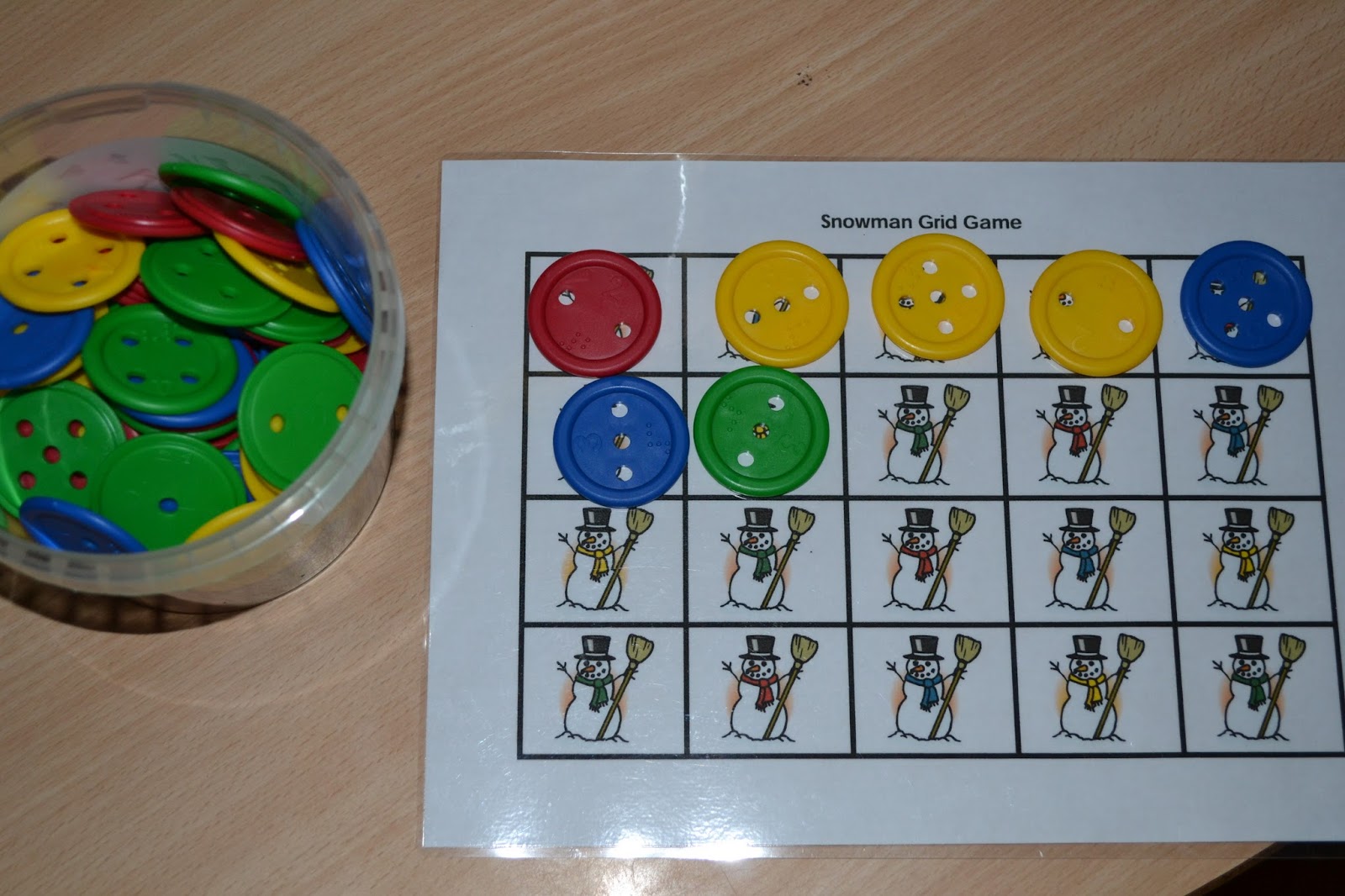
 |
| Sorry I forgot to include te dice in the pic... |
- Stamps: the children will develop their pincer grasp control by using these stamps (I only found 3 winter animals: a rabbit, a reindeer and a polar bear!)
- Gluing activity: making a snowflake following a pattern I made for them.


There are a few more activities I need to add or do witht the children. So keep checking us up over the next few days. See you soon..
Sunday, February 20, 2011
New stuff
I just purchased new Montessori materials for the playschool and I will present them to the children after our mid-term break, next Monday 28th. It is always very important to rotate activities on the shelves to keep their attention focused. New materials at playschool is always like going on an adventure!!


Hanger for coloured bead stairs - Maths

New insets tracing tray with new inset paper holder - Pre-writing skills

Shape stacker - Sensorial and Maths

Constructive triangles - 5 boxes
Subscribe to:
Posts (Atom)