Showing posts with label well being. Show all posts

Tuesday, October 10, 2017

Harvest time is here!

This week, we took a closer look at our pumpkin patch as we were talking about harvest time. What better way to show the children what harvest is all about but to let them go and harvest our pumpkins?  The children have been introduced to the cycle of life of the pumpkins several weeks ago.  We documenting each process carefully , taking pictures, printing them, gluing them in a book and adding captions depicting the pumpkin life cycle This booklet has been an on-going project and has been on our shelves since mi-September. Each time we brought the children outside to our little garden,  I would ask them to describe what they could see:

 "I can see flowers growing in the pumpkin vines"


Thursday, September 21, 2017

Our Hedgehog House

We read the Leaf Man story by this week in class. I made the story simple by saying that in every pile of leaves outside hide a leaf man. The wind blows him off across the world sometimes and he meets lots of other animals. I asked the children to recognise as many animals on each page (rabbit, squirrel, fish, turtle, chicken, etc..)


Thursday, November 10, 2016

Scaffloding preschoolers' early writing skills

Providing young children with rich writing/drawing experiences lays good foundations for literacy learning. Scaffolding preschoolers' early writing skills is of paramount importance. But the diversity of skill levels can sometimes present a challenge. Some children are still at the stage of scribbling while others are drawing neat pictures from their imagination. Some are still colouring or drawing while others have started making "signs" or formed "letters". So what could I do to encourage my children, support their development level and shape their learning experiences? I took a step back and observed the children in my classroom. One little girl, one day, was playing with a small Montessori numeral rod a wooden box turned upside down. She told me she was drawing! And it hit me. Diversifying writing materials as often and as much possible was a must. Crayons, paint, markers, chalk are a great start but what about the canvas? It doesn't always have to be paper or card. Just gather materials, present it to the children and let them use their imagination. Let them use the materials whichever way they want without preconceived ideas or expectations. Then the possibilities are endless, really, and so are the learning experiences.

Tuesday, October 25, 2016

10 timid Little Ghosts - Props

We have been reading 10 Timid Ghosts by Jennifer O'Connell for the past 2 weeks in the classroom. The children love this story. I guess the story has mesmerised them because it represents everything scary about Halloween: witch, ghosts, cats, rats, vampires, skeletons etc.. It is spooky without being frightening and it got their attention straight away. The rhyming and repetitive prose is catchy and easy  to memorise making it fun, while the illustrations are really colourful and detailed. 

Wednesday, September 21, 2016

If you can walk, you can dance. If you can talk, you can sing (Zimbabwe Proverb)

It was a very rainy day today. Horrible day really. We really couldn't go out, so we asked the children after snack time, what they thought we should be doing now. And they all agreed that they wanted to dance and play fun games with the music.  So that's what we did. 

The bee dance

I asked the children to follow the rhythm: they had to pretend to be little bees. When the music was fast, they had to dance fast ; when the music slowed down, they had to slow down too. They LOVED it!! They had so much fun, it was amazing. 

Musical statues

We also played musical statues and I chose tunes which went very quiet and suddenly very loud: Flight of the Bumble Bee by Rimsky Karakov, In the Hall of the Mountain King by Edvard Grieg  or The Return of the Animals by Danny Kosarin. The children had to concentrate a lot. At the beginning, they thought I had paused the music and froze, when the music had only really got quiet. It took them a while to get it right and adjust their movements to it but this was part of the fun! How wonderful it is that with very little effort, a teacher can bring such happiness to children each day just by providing the opportunity to do a little something with music. 

Wednesday, December 16, 2015

Christmas messy dough

Why should children enjoy messy (also known as sensory) play? Well scientific research shows that the brain is stimulated through movement and the senses. To ensure the circuit of a child's brain reaches its full potential, then sensory experiences are vital. So we did get messy! We made salt dough together (messy, gooey!!!). And the children shaped the dough into little gingerbread men.

Monday, May 18, 2015

Survival of the fittest?

Just a quick look at our growing tadpoles! We had them in a giant container at the side of the house and I had the children looking at them from time to time. Until the children and I realised that something was killing them. One little boy spotted something moving in the water and after further investigation, we found out that the container was inhabited by other "pond" creatures. Our killer was called (as we found out later) the Great Diving Beetles. The children were both devastated it was killing the tadpoles but they were also so intrigued by the "monster" (as one little girl called the beetle).


So armed with our laptop, Tanya and I and the children did a little bit of research and we found out that these larvae are the young stage of a large water beetle. They live in freshwater ponds and are fierce carnivores. They sink their large, pointed, sickle-shaped jaws into their prey. Digestive enzymes are pumped into the body of the prey and the resulting 'soup' is sucked back up. Nice!!! And guess what? Their favourite prey include tadpoles!! But they will eat anything they can catch! We even saw one of them with a poor little tadpole caught in its jaws... So, we decided we couldn't let the beetle kill the rest of the tadpoles. We had to save the remaining ones. I asked the children " what can we do then to save them?". Some offered to kill the beetle. I explained that the beetle was entitled to live just as much as the tadpoles and that it wasn't killing them because it was a nasty bug but because it needed to eat to grow. So some other children came up with the idea to scoop up the tadpoles and put them in a different container and to put a lid on it at night time to prevent any other bug to get in. I found a much smaller bucket,and Operation "Save the Tadpoles" took place. We placed the bucket by the preschool entrance (putting them in a large container was my husband's great idea!!!).


Needless to say that the larvae was not very popular among the kids!! 

Yet, they were completely fascinated by what had happened and by the sight of the larvae.They showed a great sense of wonder and showed good reflection skills and problem-solving skills too, in their attempt to care for their environment.They felt confident that their ideas were taken into consideration and that we, adults, listened to their suggestions. It was also a great practical way to learn how to respect life, any type of life and to learn about their natural environment. The whole learning experience showed them as well that they were well able to interact with other children by listening, duscussing and they all took turns in the conversations, either by offering solutions or by expressing they sadness, their fear or their anger towards the beettle. 

To enhance their learning, I suggest to introduce them to the life cycle of the frogs using the Montessori 3-part cards and learning a bit more about what frogs do using this book below:


Friday, February 27, 2015

Where do you come from?

We have been talking a lot about how children around the world live... What's different, and what's the same.. We have used books such as Playtime or Homes or even Hair to make the children become aware of the differences around them.

Thursday, October 3, 2013

Play Dough Fun

I heard one mother the other day talking about how she has never encouraged her children to play with play dough in their house because she said she simply could not cope with MESS!! 

Saturday, September 28, 2013

The Little Red Hen

If you have read my last post (here), you know how strong I feel about fairy tales. So, two weeks ago, we started reading the Little Red Hen as its moral teaching coincides with what we are working on with the children this September: work ethics, personal initiative, responsibility and cooperation and much much more.

Saturday, September 14, 2013

Expanding the lessons of the Kissing Hand

One of the books I like to use at the beginning of a school year is the Kissing Hand. It's about a little raccoon Chester who doesn't want to leave his mother to go to school.

Monday, September 9, 2013

Planning our 1st provocation

We talked about how we wanted students to interact with our classroom. We didn’t want them to come in and know every day what the block area or the writing centre for instance contained . I want the children to arrive in class and wonder what they will come up with in each centre. the environment must be dynamic and evolve on a regular routine. Don't you agree that thanks to such a classroom, the children's interest and curiosity will grow?  I have never put all the materials out at the beginning of the year. I gradually add, remove etc.. depending on the children's learning pace and their interests too. This is another aspect of creating a dynamic teaching environment.  I have learnt that each year bring us a "bunch" of different kids who love doing things completely different than the past pupils. What Reggio teachers often do as well is add a new game/toy/apparatus etc.. and let the children discover it themselves.

From what I have studied so far, one of the most important concepts of the Reggio Emilia Approach is the "provocation".   What I understand (and please correct me if I am wrong) is that a provocation could be an image, an object, a group of images or a group of objects. It could be a sound, a series of sounds, a piece of music. It could also be any event or experience that leads to more discussion, curiosity, excitement...  Provocations can be pre-planned, structured and arranged while some of them are more open-ended.

So, I have been re-thinking activities in our classroom. I want them to be about exploration and discovery through their senses. I want the activities to prompt the children  to ask more questions, to plan and to think deeply. To do so, I have to observe what the children are interested in or at least guess. I have to take into consideration what they already know and then plan the activity.
 
 
Here is the 1st provocation I set up. I had noticed the children looking at themselves in the various mirrors in the classroom. They have also been quite drawn to the writing centre to colour. I assumed that exploring a new art medium would be a great idea and I presented a mirror in the writing centre. I sat at the table beside a child and observed. It didn't take the child very long to start making faces in the mirror and start laughing saying : "look, this is another me and it is doing all what I am doing!".. So I prompted the child a bit further and asked him to describe himself. When he said he had brown eyes, I asked him if we had the same colour in our crayons basket. When he said he had dark yellow hair, I repeated the question. We moved on to the skin and the lips colour. Finally, I asked him what shape was his face? His eyes? His mouth? And the rest followed:


And funny enough, once we were finished, we had a group of children waiting for their turn to "draw themselves"!! Brilliant!
 
At circle time, I reinforce the concept of identity and we talked with the children about how there are things about each of them that are the same and there are things about each of them that are different. We had all the preschoolers with blond hair to stand up ,all preschoolers who have brown eyes to stand up. And we also read:

    • I'm Glad to be Me by P.K. Hallinan
    • I Know What I Like by Norma Simon


Thursday, February 28, 2013

An Australian Ballad....


Yesterday, I introduced the children to our new continent: Australia. I set up 2 main baskets on our geography unit: one representing the landmarks of Australia and one depicting the animals living on the continent. I also placed the Australian flag on the unit counter as well as books about the continent in question.


(It is quite funny to observe children walking in the classroom in the morning: no matter what you have changed, removed or added in the setting, they will spot it staright away and they are automatically drawn to the new activity or the new material!!)
 
At circle time, I used the 3 part cards about animals. I have information written in the back of each picture and I read it to them as we discovered the animals living in Australia. I then read them the story about how koalas got a stumpy tail (it's only a legend but the book actually gives lots of acurate facts about the animals mentioned in the story).


But I have to say that my favourite book is Sail Away, The Ballad of Skip & Nell by Mem Fox. We've been reading about the story two delightful little dingoes who started a  rather long journey around Australia, in search of a boat race. This story is a great introduction to Australian Geography and Australian Animals and it ties the 2 baskets I have introduced SO well. It takes us to nearly every state and territory in Australia. What more do you want. And along the way, we discover new animals living in Australia!!

 
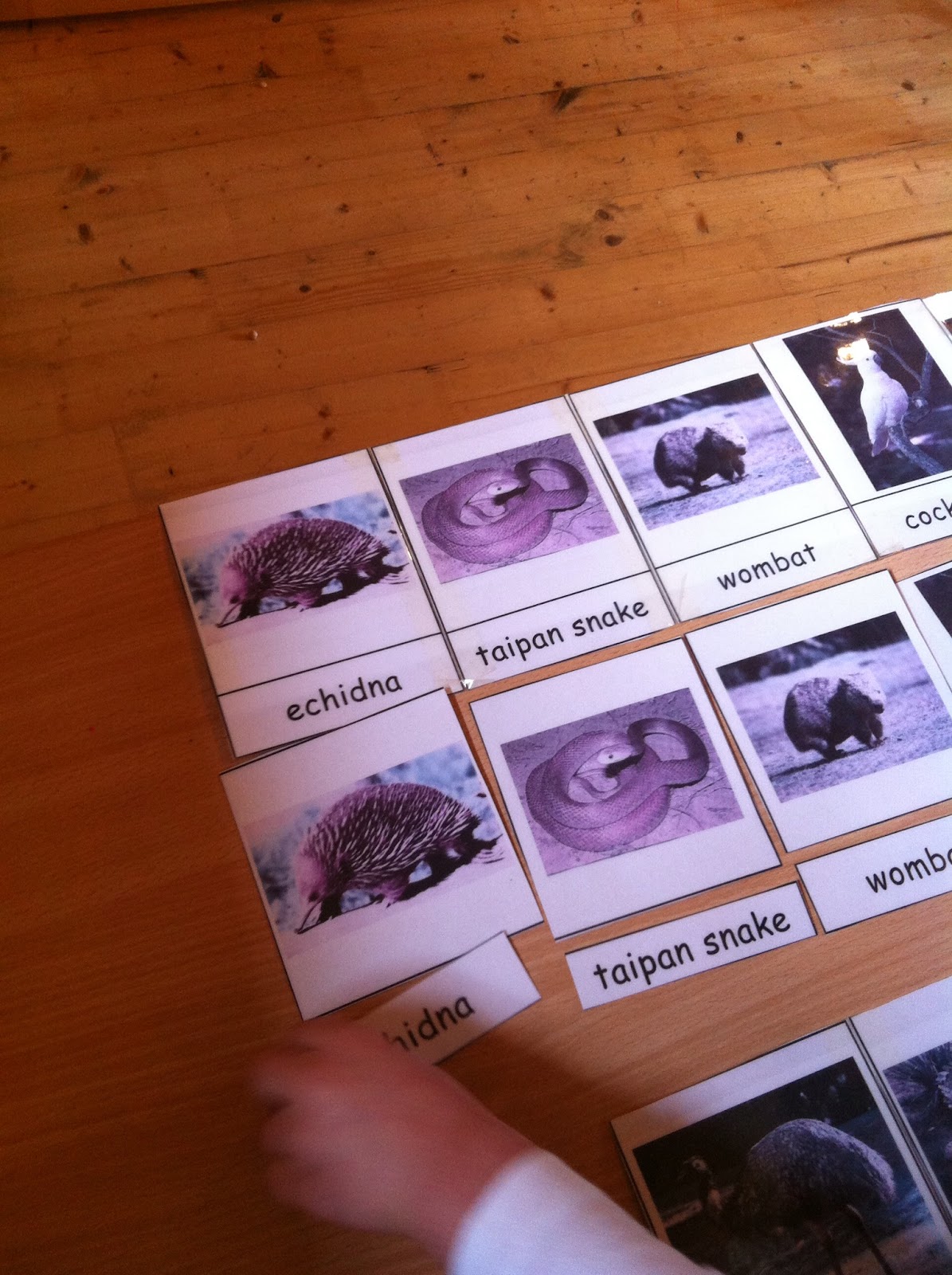
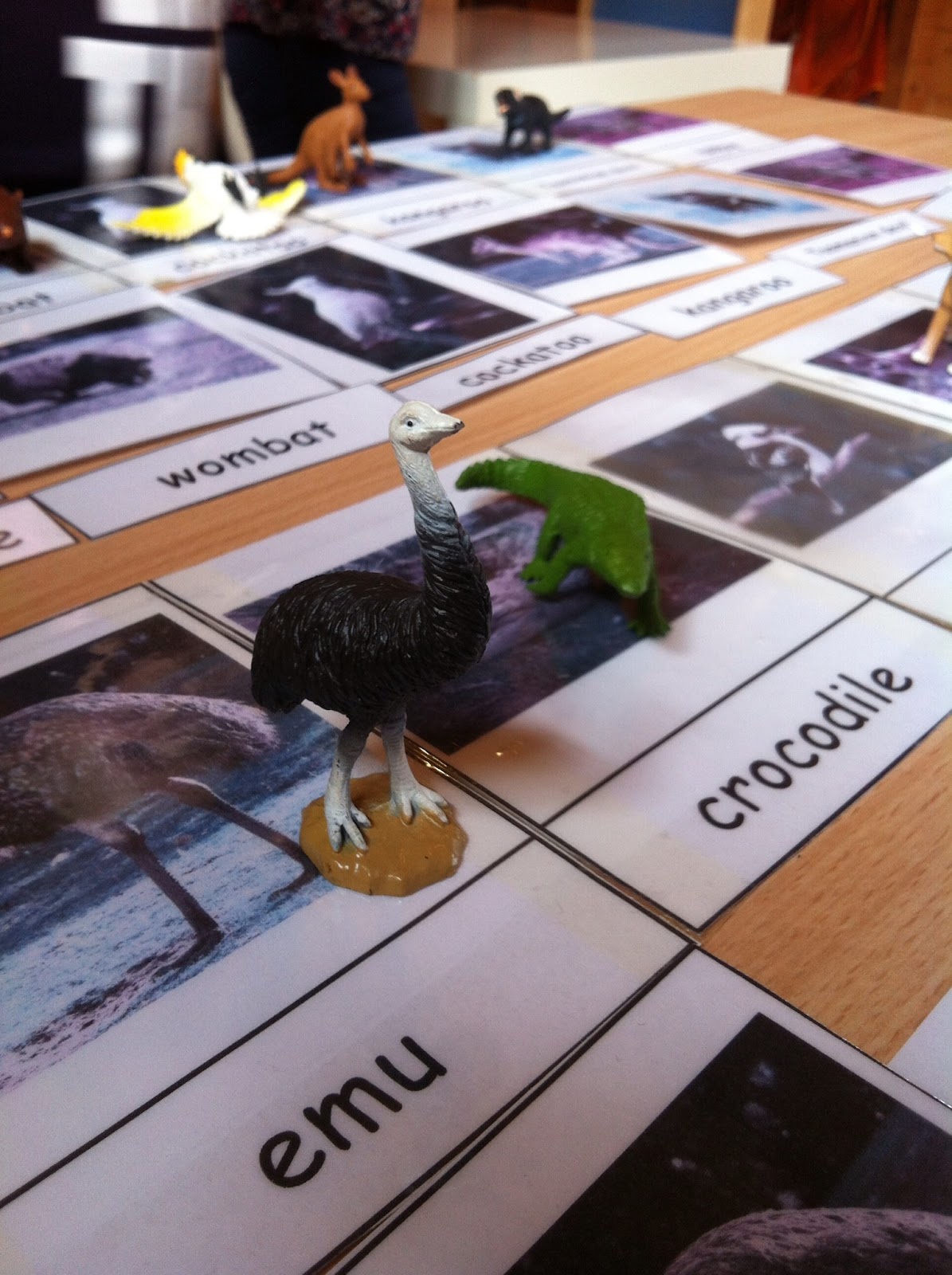
Later on, I showed the children how to use the 3 part cards with the plastic animals I got from The Land Down Under Toob. They first start by matching the cards to the booklet I made.


Then, they find the corresponding written name of the animals (great pre-reading skills even for non-readers).


Finally, the children can match the platic toy animals to the pictures.


Of course, the children are also allowed to use the animals just for fun!!!
 
Next, I introduce the children to the Australian landmarks 3-part cards. Same principle. I added a twist by collecting a few postcards and asking the children to match them up to the right picture card! I wish I had a lot more postcards but this will do for now.


So, this is what the children are learning about at the moment. Later on, I will add fun facts and pictures about Australia as well as pictures about aboriginee art (cave painting, dot painting et..). My Australia continent box is an on-going project and apart from a few postcards, a few coins and my plastic animals, I actually do not have many items.
And just inc case some of you ask,  I can't even remember where I got the 3-part cards. My guess? Montessori Tidbits. I apologise if I am wrong (please send me a message to correct me I am referring to the wrong person!). However, if you are looking for more stuff, check it on Montessori for Everyone (they have brilliant and affordable continent kits there.)  I hope this helps. Keep in touch!


Monday, September 24, 2012

New rules in the classroom

This year, I realised after these first 3 weeks that tidying up is not one top priority for my preschoolers and as we have so many boys in our group, they usually like to gather all together on the main mat, tipping boxes together and  "messing" together. I can't call it "playing", "learning" or "working" as there is absolutely no constructive activity... Rachel and I have had to restructure their little group constantly and redirecting their work/play. They were not able to choose exercises on their own. So this week end, I thought long and hard about what I could do to change this and help them focus a bit more.
 
Choosing an activity on their own and tidying up carefully is very important as it helps preschoolers to develop their sense of responsibility. How a child learns to clean up now sets the stage for how they will complete the exercise later. When a child chooses his/her games/activity, this also shows that they have reached a certain level of maturity and that they are quite self-assertive and confident. What could I do?
 
I want the children to learn that some materials can only be played with on a mat or at the table, that some activities are for 2 children at a time only, that others require more concentration and can only can be played by one person. I also want them to realise that we are a "use the mat" environement and that everybody need their own working space. From now on, I only authorise 2 players on the big mat in our book corner. No more big boisterous groups of boys playing war and shooting on the mat!!!
 

So I tried to turn all these rules into a game and created labels/cards with the pictures of a type of materials/activity. Below each picture of the activity, I added a mat or a table to indicate where this should be played with. I laminated the cards, punched 2 holes and laced a string through to make a necklace. I explained the children that from now on, if the necklaces corresponding to the activity were all taken/used, this meant that they had to go and find something else to do until it was their turn. I remined them all of where the materials went and where the floor and table mats were stored. The kids loved the idea and really took to the "game". It worked wonders today. We got a lot more done today and it was so much more peaceful and organised!!! I hope this system will keep working. I will let you know.


We are now using these little necklaces for the dinos, the animals, the brown stairs, the Pink Tower, any of our constructin materials and for Play dough. 


Wednesday, September 12, 2012

Separation Anxiety.. What to do?

Leaving Mammy can be hard!! Especially if you spend all your time with mammy and suddenly, you ar ebeing asked to stay in a new environmnt with complete strangers and so many little faces !! So managing separatin anxiety can be tough for some kids and for some parents too!! Parents often drop off their little one at preschool with a pit in their stomach, knowing what's coming next:  a fit, kicking, screaming and crying, not wanting  to be left behind. Parents know this won't go on forever, but it sure feels like it lasts a lifetime.
 
So what do we do? I always tell parents that the simplest of the steps is to say good bye, which is also the hardest to do. Parents should give their child a hug and a kiss, tell her/him they'll be back soon and then walk out the door. There should be no delay, no more "one more minute," no lingering, hoping that she/he 'll miraculously start smiling and laughing, happy to go and play with her/his preschool chums. But I understand that this can be way TOO hard for some parents to do. So sometimes, we have to employ different strategies. Parents are always welcome to stay with their little ones at the beginning, for an hour, or even a full session if necessary. This helps the child to get used to his/her new environment and get to know his/her teachers. After a while, I usually suggest that it is time to be firmer and to stay for only a few minutes. Parents must explain the child  that they are now leaving but will be back very soon. There will be tears. Children can be stubborned and think that if crying worked in the past, it will work again. At that stage, it is important to stick to your guns.(Easier said than done, I know.... but I have been there myself and believe me, I know what I am talking about).
 
Some parents prefer to sneak out when the child is engrossed in an activity. It is really up to every individual. The reality is, that within minutes of their parents' exit, most kids happily settle down and forget what all the fuss was about. And within days (sometimes weeks), the tearful goodbyes end. The key to success is PATIENCE... This might take weeks but the child will eventually accept the new routine. We currently have a mam who has to stay with her little one during the whole session in the morning. Progress is slow as the child refuses to do anything if her mam is not right beside her. She keeps a VERY close eye on her mother and at the moment, sneaking out is not an option. But with a bit  more time, the child will settle down. Mam might have to eventually be a bit tougher and just leave (kids are so clever and know that tears DO break mammies' hearts!!). But I have no doubt that she will settle down... It is harder for some and all we can give them is lots of love, attention and patience.
 
However, last year I bought a book called The kissing hand by Audrey Penn. It is a very cute story about a Racoon who doesn't want to leave his mam to go to school. This year, I read the book again and created a new activity which I thought could help separation anxiety: the children made a key ring carrying 2 of their hand prints: one handprint made out of paint and one cut out of patterned paper. I laminated both, cut them out, punched a hole in them and tied them together to a key ring. I told the children that they could get their mams to kiss the handprints before coming to preschool. This way, they carry their mammies' love with them wherever they go. They can put the key ring on their belt or on their school bag. I also wrote the story on a Word document and distributed it to parents. This way, they can share the story with their kids and help them settle down. Parents seem to respond very well to the idea of the Kissing Hand and the children love telling us how many kisses their mam or dad gave them to bring to school.


Settling down into a routine

The first few weeks in September are always a time to settle down and get used to the new rules and the new environment. This is also a time during which children get used to one another and get to know one another. So we are taking it easy and the children are discovering or re-discovering new games or materials.
 
I had this simple game last year in our classroom. I cut an opening in the plastic lid and children loved sliding round tokens made out of cardboard. I decided to print the children's faces and laminate them all. I then cut them in a circle. The children are now using these instead of the old cardboard tokens. This is very popular as they love looking at their own pictures and really enjoy recognising their friends on the tokens. This is a nice way for them to learn each other's names too. And this help the children to eercise their fine motor skills in preparation for writing. They have been shown how to grasp the laminted tokens between their thumb, middle finger and the index.
 
 
Here is another activity on our Practical life shelf that is quite popular among the boys. I bought several new locks and voila.. Great practice for these little fingers! 


More activities on our Practical Life shelf: hammering


At the moment, our jigsaws in our science corner are very popular. The children sit together spontaneously by group of 3 or 4 and pick /exchange these jigsaws and comment a lot on what they see. Brilliant exchange of knowledge!!


And of course, what would we be without our play dough!!! This is such a fun activity !


Sunday, July 1, 2012

Sport Day

God ! What a week we've had! Between organising our portfolios (which took me ages) and our graduation party, I haven't had time to breathe!!! But holidays have now started and I can relax and catch up on my blog!!

So today, I will share with you the photographs I took during our Sport Day with the "graduating" children. It was so much fun and for once, the sun was shining!


Egg race

Running backwards


I have many other pictures but it would take me ages to download them all. After the races, we presented the children with Oympic medals... They were so proud!