Providing young children with rich writing/drawing experiences lays good foundations for literacy learning. Scaffolding preschoolers' early writing skills is of paramount importance. But the diversity of skill levels can sometimes present a challenge. Some children are still at the stage of scribbling while others are drawing neat pictures from their imagination. Some are still colouring or drawing while others have started making "signs" or formed "letters". So what could I do to encourage my children, support their development level and shape their learning experiences? I took a step back and observed the children in my classroom. One little girl, one day, was playing with a small Montessori numeral rod a wooden box turned upside down. She told me she was drawing! And it hit me. Diversifying writing materials as often and as much possible was a must. Crayons, paint, markers, chalk are a great start but what about the canvas? It doesn't always have to be paper or card. Just gather materials, present it to the children and let them use their imagination. Let them use the materials whichever way they want without preconceived ideas or expectations. Then the possibilities are endless, really, and so are the learning experiences.

Showing posts with label writing. Show all posts
Showing posts with label writing. Show all posts
Thursday, November 10, 2016
Monday, June 9, 2014
Pebbles for numeracy and literacy
This year, I have tried to follow the Reggio Emilia principles to enhance my children's learning . Now, there is no text book as you know and it is sometimes hard to figure out which way is the best. However, from what I have learnt so far, I understand that the materials I use are extremely important. This year, I have tried to select very carefully each materials I use for their potential to enhance learning and discovery.
Sunday, January 5, 2014
Working hard
Here are a few pictures of what the children were up to the few weeks leading to xmas...
a bit of pre-writing....


Sensorial activities....


Developing fine motor skills with the Practical Life exercises...

a bit of pre-writing....

A bit of maths ...
 |
| Montessori Cards & Counters |
 |
| Montessori spindle box |

 |
| Shapes |

 |
| introduction to halves, quarters and thirds |
Sensorial activities....
 |
| Waldorf tower.. using the circle first on their own, sorting them out by size |
 |
| then using the rectangles alone, sorting them by length |

 |
| all together now |
 |
| more soring exercises by colour and shape |


 |
| shape and colour again while developing fine motor skills |
 |
| associating colour to matching picture |
Developing fine motor skills with the Practical Life exercises...


 |
| jigsaws are great for little fingers but also develop problem solving skills, concentration, hand eye coordination etc.. |
 |
| as you can see, we are using the Montessori teen beads for the sole purpose of refining fine motor skills (no number, no counting). the hooking up movement is a great exercise for little ones .... |

Wednesday, November 14, 2012
Developmental fine motor skills
This week, I added a new type of activity to our literacy shelves, for the children to practice their handwriting. Some of them still find it very hard to hold their pencil properly and to keep a steady hand when tracing or colouring. So I printed a collection of
activity pages/sheets that can be used for pre-writing practice. I laminated them all and bound them together. The children can now use them with a dry erase pen and use a brush to clean each sheet as they have completed the exercise. Needless to say that the brush has added a great point of interest to the activity!!


Some preschool teachers will
find these useful, and some will not. Montessori advocated the use of the salt/sand box to teach the child how to write. I think that variety is a key element in a classroom and the children really like this new activity. The eye-hand co-ordination required for writing/tracing is
a very important developmental physical skill and I have found that requiring a child to
trace lines and draw from dot to dots when they are not ready is the fastest
road to fight with boredom and frustration. Children who are ready for this
work, however, can enjoy a great deal of satisfaction and a sense of order when
completing the pages too!! So it works for everybody!


Tuesday, November 6, 2012
Another pre-reading activity
Here is a little activity we have done these past 2 days. Some children can already recognise their names on their name tags without even referring to the picture attached to it. Some need a bit more practice. This exercise proved to be perfect: the children had to glue the chick peas or split red lentils onto the traced letters of their names. They really had to concentrate hard! Great way to develop their visual memory! (I am sorry if all the photos are crooked! I don't know how to fix this problem. The pictures are perfect in my folder on the computer but for some reason, they come up the wrong way sometimes when I use them on my blog!!)


Making progress in writing
The children have started learning to recognise their names since the beginning of the year. We use a very simple method: their name tags on top of their coat hangers ...

.... and the ones they use on our roll call board.

They also do work in their work copies and when asked to do so, they have to retrieve their copy, recognising their names written on the front cover (sorry,I don't have any picture).
The next step is to help them write their names down, which can be very tricky for some. But this is what preschool is all about!! Learning, practising, trying ... I wrote a post right here in the past, explaining how we proceed. Some of the children have very poor penmanship and we let them practise their skills using worksheets, joining dots at first.


I also find that tracing over words does help them a lot too. In the photo below, you can see a child tracing over words related to Autumn time. Though he cannot read yet, he is able to associate the written symbols to a meaning, thanks to the picture placed beside the written word.


Once the children are much more confident at holding their pen and tracing carefully, we move on to the tracing of their names and finally, we completely get rid of the dots. Read the post I mentioned above and you will fully understand what I am talking about.


I also find that tracing over words does help them a lot too. In the photo below, you can see a child tracing over words related to Autumn time. Though he cannot read yet, he is able to associate the written symbols to a meaning, thanks to the picture placed beside the written word.


Once the children are much more confident at holding their pen and tracing carefully, we move on to the tracing of their names and finally, we completely get rid of the dots. Read the post I mentioned above and you will fully understand what I am talking about.
This year, I have added another step: I have created little booklets for the children to help them practise the letters in their names. (I cut a work copy into 2 to make the little booklets).

Let's take JESSICA for instance.

Jessica will have to start tracing the letter J, using dots ; then she will reproduce the letter all on her own.


The procedure will be repeated for each letter of her name until she is ready to reproduce them all together independently.


The booklet is actually a great way to record how the children are progressing and how much they have achieved so far. The booklet will also be a nice little keepsake at the end of the year.
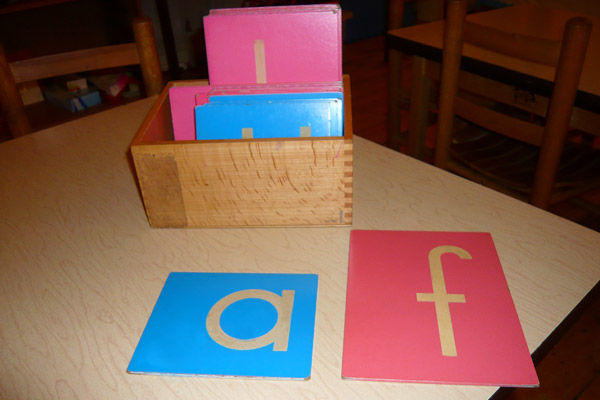
Of course, everytime we introduce a letter to the child, we will use the sand paper letters and the salt/sand box to teach him the right way to trace the letter.

Let's take JESSICA for instance.

Jessica will have to start tracing the letter J, using dots ; then she will reproduce the letter all on her own.


The procedure will be repeated for each letter of her name until she is ready to reproduce them all together independently.


The booklet is actually a great way to record how the children are progressing and how much they have achieved so far. The booklet will also be a nice little keepsake at the end of the year.
Of course, everytime we introduce a letter to the child, we will use the sand paper letters and the salt/sand box to teach him the right way to trace the letter.

In a Montessori classroom, the sand/salt box is always used as a stepping stone to many other writing and reading activities. In our preschool, we also use a dry erase board in conjunction with the salt box. It is a very effective way to practise and the children like the idea of using the brush to clean the board. Some people use chalk boards. I personally think that chalk is a bit too messy in a classroom and this is why we use dry erase boards instead.
So, over the weeks to come, this is what we wil be all at in our classroom. And by next June, all the children moving to Primary School should be able to write their names all on their own!!I will of course present the children with several other types of activity to diversify and vary the learning process and make it more interesting. So keep in touch!
So, over the weeks to come, this is what we wil be all at in our classroom. And by next June, all the children moving to Primary School should be able to write their names all on their own!!I will of course present the children with several other types of activity to diversify and vary the learning process and make it more interesting. So keep in touch!
Wednesday, September 26, 2012
The Montessori Insets
Today the children got a sudden interest in the Montessori insets. For those of you who dont know what they are, they are a set of 10 geometric shapes in metal, each coming with a frame.
The children start by choosing a frame of a curved figure, take a sheet of paper and crayons. Placing the inset on top of the sheet, the children then use a marker to slowly trace around the inside of the frame in an anti-clockwise direction. The the children fill the inside of the figure with straight lines close together, from left to right, top to bottom. Some of them asked me if they could add a few stickers for effect and I let their creative side take over!


There are several other exercises following this one, once they have mastered this exercise. I will make sure to write about these exercises in the future.
Subscribe to:
Posts (Atom)