Over the past few weeks we have introduced the children to the map of the world. They have learned to differentiate land shapes from oceans and have learned the names of each continent. Each continent is colour coded in a Montessori classroom. This helps the children to remember which is which a lot easier and they now can point at each of them on the map at circle time without any hesitation. The next step was to teach them some characteristics unique to each of the continent.

Showing posts with label geography. Show all posts
Showing posts with label geography. Show all posts
Thursday, March 31, 2016
Tuesday, May 12, 2015
Introduction to Australia
At the beginning of April, we started talking about where we live. Of course, most children were able to tell us they live in Kilmore or in Bridgetown and some were able to say they live in Ireland in County Wexford. So we pushed it a bit further and introduced them to a globe and showed them how there are 7 main continents on planet Earth. Our continent is Europe. We used our "continent song" to name each other continent and kept pointing at them on a map I made a few years ago. Each continent is colour coded according to the Montessori method of Education ( see other posts on the subject under the labels "Geography" in this journal).


Friday, February 27, 2015
Wednesday, January 15, 2014
Maping the world with our animals
In our classroom, we have collected many
“continent boxes” over the years. We use them as an addition to our traditional
Montessori folders. We have been lucky enough to swap items with many friends
across the world and in each box, we have little collection of plastic animals.
It just occurred to me one day as we were learning about the continents, that I
could gather all these animals and use them in conjunction with a large floor
world map. The children have been studying the continents for quite some time, they are now quite familiar with their names and shapes and colours. The idea
is for the children to explore the map of the world, and in particular
the countries of origin where the animals come from. I am working on a felt map to use but this is a slow process as I am not great at sewing! In the meantime, we are using the Montessori world map. I use 7 little boxes
colour-coded according to the continents on the Montessori world map. Each little box contains plastic animals from each continent.
As you can see below, I simply used plastic washing soap liquid dispensers to store the animals. I had boxes but they were either too big or too small, while some were made out of wood, wicker or plastic. I wanted something a bit more uniform but I didn't want to go and spend too much money. I suddenly realised that I had been "collecting" theses dispensers in my utility, so...voila!


How does it work? I invite a child to work with me and I point first at the colour code on each box. I ask the child to match the colour to the corresponding map and ask them to remind me of the name of the continent. The child works with one box/one continent at a time.


When he is finished, the child must tidy up, one continent at a time, placing the animals in the right tub.


How does it work? I invite a child to work with me and I point first at the colour code on each box. I ask the child to match the colour to the corresponding map and ask them to remind me of the name of the continent. The child works with one box/one continent at a time.


When he is finished, the child must tidy up, one continent at a time, placing the animals in the right tub.
The aim of the activity is to look at the countries of origin of many animals the children are familiar with, thanks to their interaction with our continent boxes. The exercise requires the child to isolate maps, to identify them on the world map, giving him/her a sensorial impression of the positions, shapes and sizes of each continent. This activity is a great revision of the continent and their names, as well as a good introduction to the animal kingdom. It also helps some of the younger kid with colour recognition. And though the activity is presented and played on a one-to-one basis, it proves to be a great team work as all kids LOVE to use the animals that way and talk about them. So not only this activity links zoology and geography but it also helps children to expand their vocabulary and engages them to converse and think.
I just need to add more animals to represent marine zoology and I am lacking animals for South America and Asia. In the progress!
Thursday, February 28, 2013
An Australian Ballad....
Yesterday, I introduced the children to our new continent: Australia. I set up 2 main baskets on our geography unit: one representing the landmarks of Australia and one depicting the animals living on the continent. I also placed the Australian flag on the unit counter as well as books about the continent in question.

(It is quite funny to observe children walking in the classroom in the morning: no matter what you have changed, removed or added in the setting, they will spot it staright away and they are automatically drawn to the new activity or the new material!!)
At circle time, I used the 3 part cards about animals. I have information written in the back of each picture and I read it to them as we discovered the animals living in Australia. I then read them the story about how koalas got a stumpy tail (it's only a legend but the book actually gives lots of acurate facts about the animals mentioned in the story).


But I have to say that my favourite book is Sail Away, The Ballad of Skip & Nell by Mem Fox. We've been reading about the story two delightful little dingoes who started a rather long journey around Australia, in search of a boat race. This story is a great introduction to Australian Geography and Australian Animals and it ties the 2 baskets I have introduced SO well. It takes us to nearly every state and territory in Australia. What more do you want. And along the way, we discover new animals living in Australia!!

Later on, I showed the children how to use the 3 part cards with the plastic animals I got from The Land Down Under Toob. They first start by matching the cards to the booklet I made.


Then, they find the corresponding written name of the animals (great pre-reading skills even for non-readers).
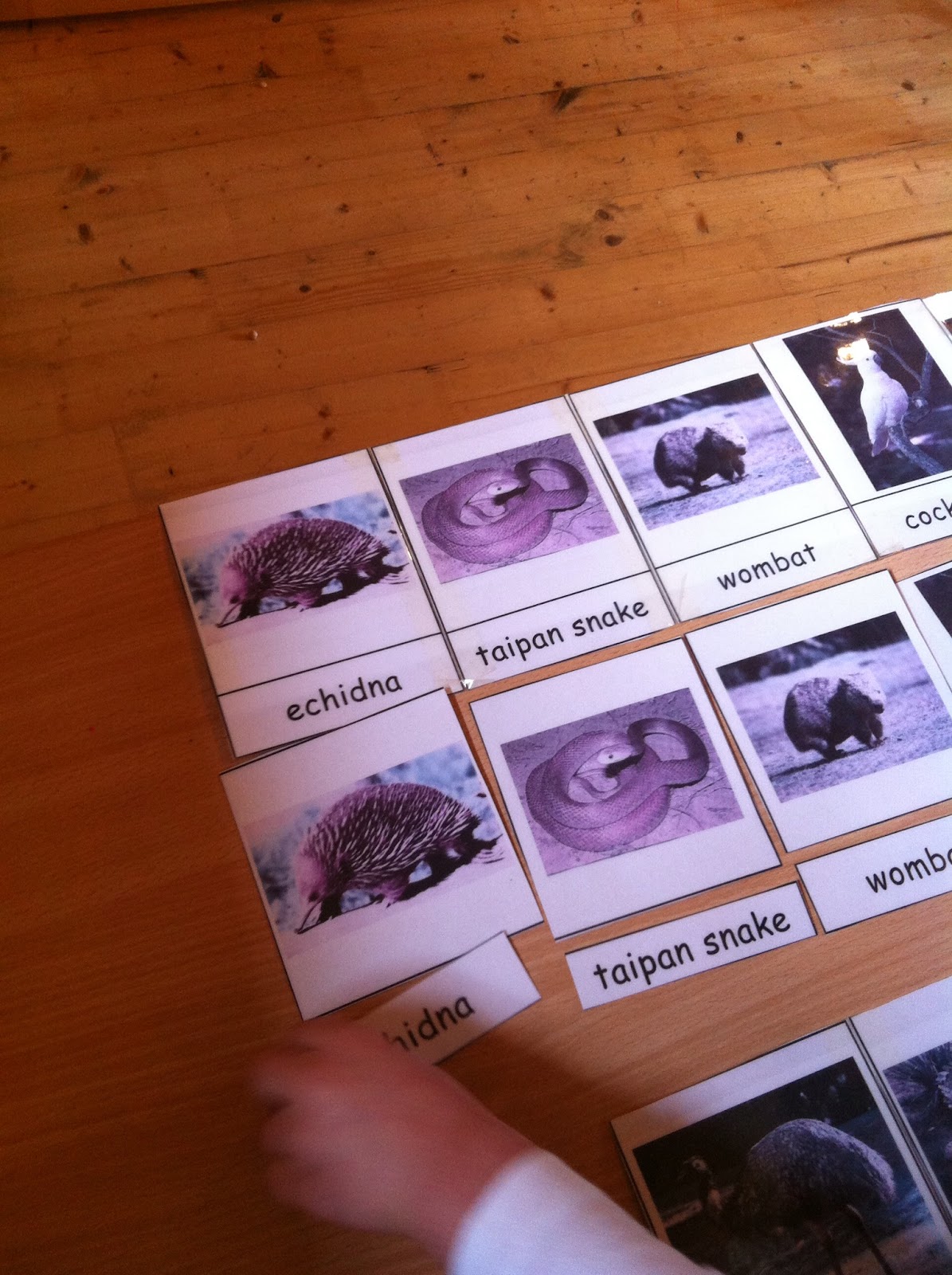
Finally, the children can match the platic toy animals to the pictures.


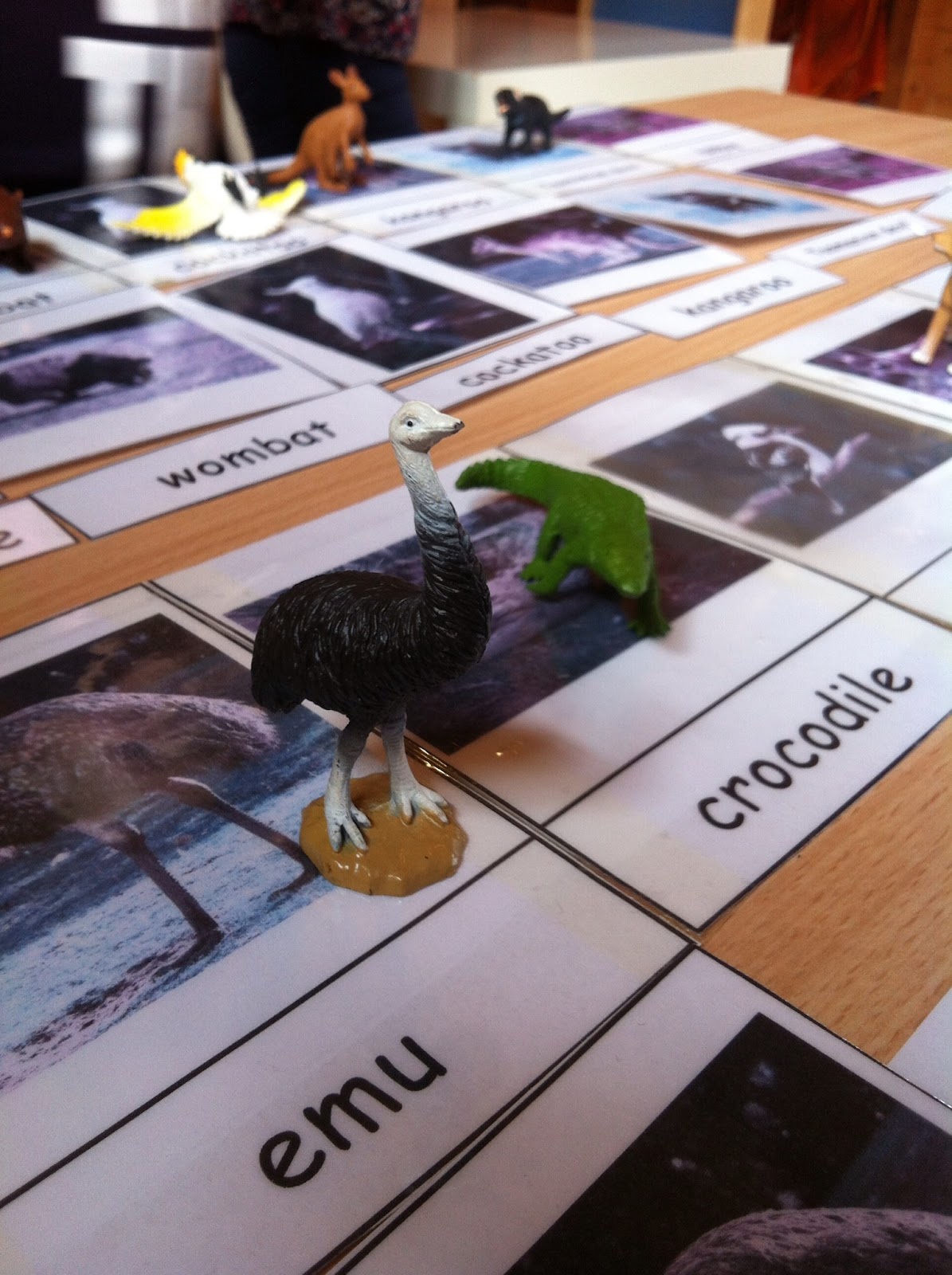
Of course, the children are also allowed to use the animals just for fun!!!
Next, I introduce the children to the Australian landmarks 3-part cards. Same principle. I added a twist by collecting a few postcards and asking the children to match them up to the right picture card! I wish I had a lot more postcards but this will do for now.


So, this is what the children are learning about at the moment. Later on, I will add fun facts and pictures about Australia as well as pictures about aboriginee art (cave painting, dot painting et..). My Australia continent box is an on-going project and apart from a few postcards, a few coins and my plastic animals, I actually do not have many items.
And just inc case some of you ask, I can't even remember where I got the 3-part cards. My guess? Montessori Tidbits. I apologise if I am wrong (please send me a message to correct me I am referring to the wrong person!). However, if you are looking for more stuff, check it on Montessori for Everyone (they have brilliant and affordable continent kits there.) I hope this helps. Keep in touch!
Wednesday, February 20, 2013
Our Antarctica continent box
As the children grew more and more confident identifying continent shapes, I introduced the children to our Antarctica box.Why starting with this one? Because we were still right in the middle of winter and the box fitted well with our Winter theme in the classroom. This box is definitely not finished and I am trying to gather more plastic animal to match our 3-part cards distinguishing animals living in the arctic world. Children have responded quite well to this new way of presenting a continent. What I used to do in the past was to leave a full box in our geography corner and let the children root though it. I did find the exercise quite upseting as the children were only using it as a treasure box, messing everything and not really learning anything. This year, I decided to introduce the children to the contents of the box gradually. To do so, I used several trays to display the materials.

We started with pictures of some landmarks. The children used the 3-part cards matching the cards together and noticing what they could see as they went along: water, ice, iceberg, snow, moutains etc... I didnt insist too much on the specific name sof these landmarks as long as they registered distinctively the major traits of the Antarctic landscape.

Then, I added another tray with simple cards representing what goes on in Antarctica. The children were amazed to discover that some small boats need to break the ice in the sea to allow bigger boats to get through. They also had a look at the ice pics used to climb mountains and the special spiked boots required to be able to walk in an icy and slippery environment.

Another time, I introduced a tray with 3 part-cards of animals that can be find in Antarctica. I got all the materials from Montessori for Everyone, laminated them and bound them together.
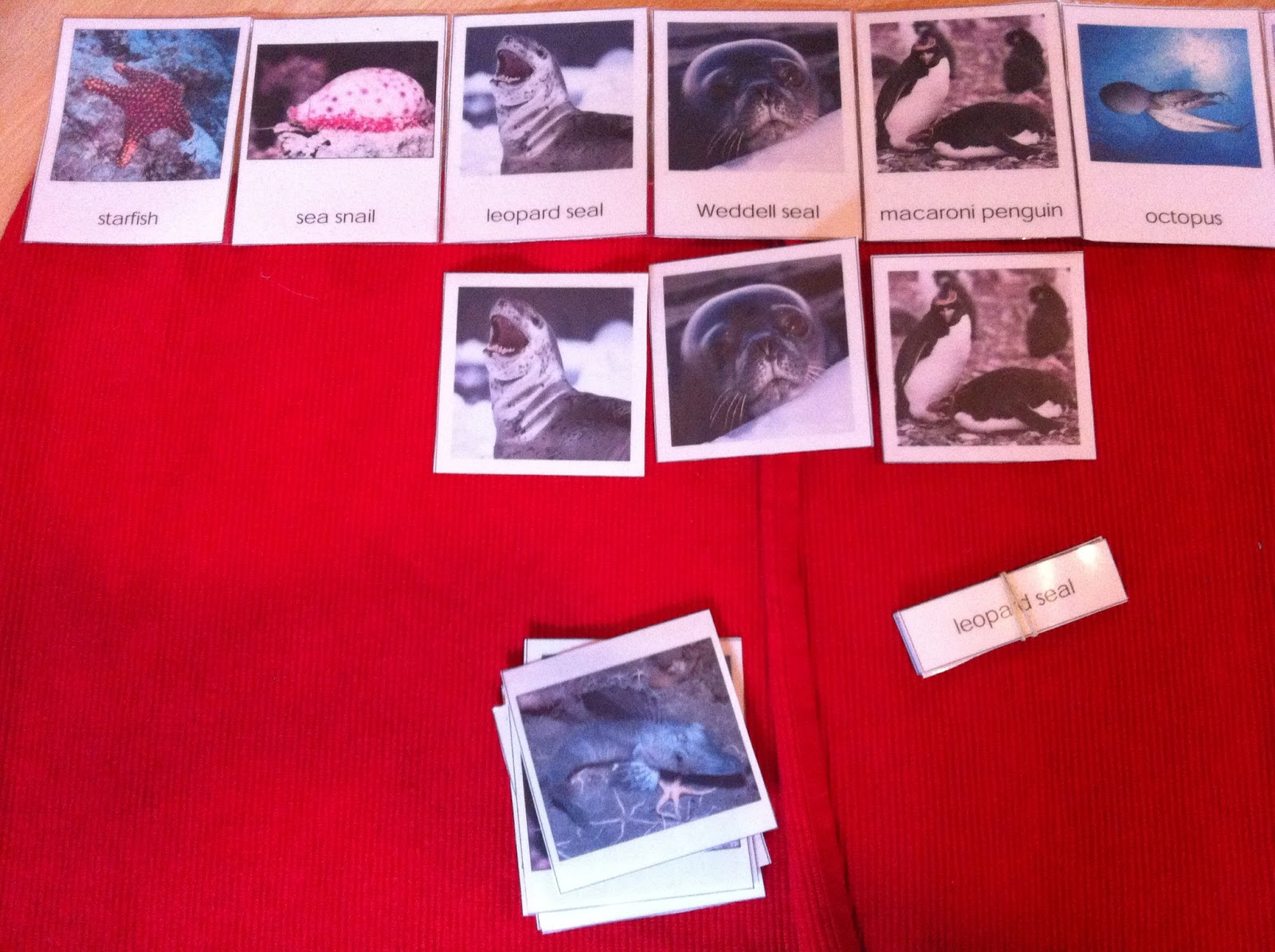
When the kids were a bit more familiar with these animals, we went look in more details into a certain type of animals: penguins!

This was so much fun to extend the study to other areas of the classroom: books in the circle-time corner, drawing and pre-writing skills area (we did the same activities as last year, see right here) etc... Later on, I added plastic animals. I am still looking for a whale, an octopus, a seal and a star fish to add to our collection. But I'll get there!

Tuesday, February 12, 2013
Tell me the continents...
Geography is a huge part of our curriculum. Children's queries about the world show that the interest and the curiosity towards geography emerge at early ages. I think it's really important to encourage children's curiosity and their enthusiasm for exploring their environment. Geography teaching makes children more sensitive to their surroundings and to other environments and cultures. Besides, Montessori education helps children develop an understanding of their place in the universe. In fact, Montessori education is often called a "cosmic education." To this end, children are presented with the big picture first. One thing that I like to do early on in the school year is to teach the children the "continents song" at circle time. And I know some of you, parents, are smiling right now, as many of you have told me that your little ones keep singing the song again and again!! While singing this, I have the continent map in front of me or the globe ( or a laminated map) and I point to the various continents as we sing them.
Once they have been introduced to the map, I let them practice the names of the continents by using three part cards. The children learn to associate the names of the continents to the shapes and colours.


Today, the children made their own little folding booklet to bring home. I had prepared the Booklets beforehand. Using the template of the 3 part cards, they reproduced the pattern. This was such a popular activity!! The children were so proud to bring them home!


Tuesday, September 25, 2012
Our solar system
One of Montessori main principles is Cosmic education. It is founded on the belief of
integration and interconnection. I know, it sounds complex, but it is not at all! Cosmic education is a way to show the student
how everything in the universe is interrelated and interdependent. Everything
has a part to play to the maintenance of harmony in the whole. In understanding
this network of relationships, the child finds that he or she also is a part of
the whole, and has a part to play. So here we were yesterday and today, giving the children in our classroom their first sense of he universe: our solar system and the planets. The children love this topic. I use a song to help the remember the sequence of the planets (from the closest to the sun). I made a frieze with details of each planet on the back. I then showed the children how to use our 3 part-cards.
The children unfold the frieze. They hen have to match the corresponding cards under each pictures. Then they use the name cards and math the name of the planets to the frieze. Even tough the children cannot read, this is a very good reading exercise as this helps them recognise symbols and understands that there is a meaning behind them. I have placed coloured stickers behind the pictures to be used as control of error. This means that, once the child has completed the exercise, he/she can check if he/she did it right by checking the stickers on the back. Sorry, but I forgot to take a picture of it (but you get the idea!).


This is a great game as it capture the children’s imagination and inititate the children's exploration of important questions. I have been so pleased with their interest and once again, their desire to discover and learn has amazed me. This type of exercise also help to promote concentration and self-discipline.
Monday, May 28, 2012
International Cultural Exchange - part 3
Our international exchange is very slow at taking shape. Response is very slow .... Is there nobody interested in adding to their cultural boxes? This is such a simple and fun way to learn about the rest of the world! If you are interested in joining the exchange, please email me at mymontessoripreschool@yahoo.com
Have a look at the details in this post right here.
Have a look at the details in this post right here.
Friday, May 18, 2012
International Cultural Exchange on our blog!
I have thought long and hard about organising a cultural exchange. I did one before and it has been so much fun. A lot of work but fun! So today, I am sending a meassage to all of my readers. If you are interested, please send me a message on mymontessoripreschool@yahoo.com with your name, your address and if you are homeschooling or if you are working in a preschool setting. Could you also please put your country in the subject line of the email?
PLEASE do not sign up if you do not intend to send any packages!!!! This wouldn't not be fair on those who did spend time gathering their items and paying the postage! To make things even clearer, I think we should have a date set up by which all packages would have to be sent. We will decide on this at a later stage, once I have organised all the groups and sent everybody with their details. I will answer each email to confirm your place in the exchange. Be assured that your personal details will not be shared on this blog and confidentiality is of utmost importance. Your details will only be shared with the people allocated to your group. In the meantime, keep checking this blog for new updates.
I was planning on creating groups of 6 people. Each group will basically send 5 packages and receive 5 from around the world. I will try to make each group as diversified as possible.
Here are some ideas of what could be included in a package (but please, do not feel restricted by the list!):
-Pictures of your school, your house, your church etc...
- Items depicting the national/regional sport
- Sample of food typical to your region
- any items representing your area (cooking utensils, key holders, badges, pins, hats, decorative objects etc..)
- Postcards, stamps, coins,
-Craft representing your country or continent.
- Worksheets or coloring sheets about your country/continent or books on cd (we received several of these and LOVE them).
- Recipes, pics of food specific to your region
- Stories about your country
- Items of clothing that can be found only in your area
.. basically anything you think could be of interest to a child in another country, and anything else that you think would be fun for a child to receive. As long as it is related to your country or your region! So what do you think? Are you in?
Wednesday, May 2, 2012
Continents and Oceans Maps
As part of our study on geography and the world around us, I have been teaching the names of th oceans to the children in our classroom. It is quite interesting to see how eager they are to learn more and more and to understand what goes on around them.
I made a Continents and Oceans map, using white A4 sheets and laminating pouches. I traced the map of the world on both sheets, coloured the continents according to the Montessori coloured globe and the oceans in blue.
One map has the names of the continents and oceans written on the map (Indian Ocean, Atlantic Ocean, Pacific Ocean and Arctic Ocean). The second map is blank and comes with name slips. This is a matching exercise as the children cannot read yet of course, but this really helps them recognising letters in sequence. This is a teacher guided exercise too which means that I read each word on the name slips for them before they try to match them.


This is a simple exercise that really forces the child to concentrate. It reinforces his knowledge of the continent too and gives them a great sense of achievement once they have completed the whole exercise.
Tuesday, May 1, 2012
Montessori Cosmic Education
All over the blogosphere, on homeschool teaching blogs and early childhood education blogs, we talk about maths, literacy, physical education, but we don't give enough credit to the importance of cultura subjects in our currciculum: science, botany, zoology, history, geography, art and music...
Culture was not part of the Montessori curriculum. However, Montessori realised the importance and necessity of such a curriculum if she wanted her education to complete its cycle and be fully holistic and cosmic. Cosmic education is founded on the belief on integration and interconnection. Cosmic education opens up the child's mind and lets him discover that everything in the universe is interrelated and interdependent. Everything has a part to play to maintain harmony. When the child has understood how connected things in the universe are, he then realises that he or she also is a part of the whole, and has a part to play. Montessori spent so mch time observing children. She realised that young children interact with the natural world everywhere they go: smeling flowers, picking up leaves and feeling them, watching ants at work etc.. This is how they learn and understand how things work. Montessori believed it is important to provide the child with hands on experiences with real things before teaching them the specific names of these "things". When a child discovers something new, he is inquisitive and asks questions such as : “What is this? What is it called? How does it feel/smell/taste/sound?”. As you can see, the child try to understand using his senses. In this sensitive period, children should be encouraged to explore their environment with their senses. Awake their senses and then move on to more abstract concepts such as the parts of the tree, the life cycle of a frog etc.. Montessori realized that young children in the period of the absorbent mind have a real need to learn the proper names for things. This is why she created the Montessori nomenclature materials (3-part cards, charts, and booklets along with their controls of error) to help children develop their vocabulary and increase their understanding of the world around them. Once the child has learnt to use his senses as a steping stone to understand the world around him, he will then start grasping more abstract concepts. For example, a child learns about shapes with the Montessori geometric cabinet or the geometric solids. This will later help him discover that his environment is made up of circles, squares and triangles. in the classroom, outside, at home etc..
Maria Montessori believed that introducing cultural subjects to young children had many benefits to the children: they capture their imagination, force them to ask questions, stimulate their needs to learn, make them more aware of the natural world, inspire them and instil in students reverence and gratitude for the people and accomplishments of the past.
So following the Cosmic plan, the idea is to go from big to small, from general to specific. First, you give the child an all-encompassing sense of the universe with its billions of galaxies. Then it focuses, on our Galaxy, the Milky Way, our solar system, planet Earth and its geological history, the first specimens of life, all species of plants and animals and finally human beings. What is inherent in this curriculum is that everything is interconnected. For example, at some stage the child learns about life cycles. He learns how the common fly reproduces and this way, the child also finds out that fly lays its eggs on dead creatures, its offspring devouring the tissues to feed thus ridding the environment of dead matter, that would otherwise pile up and pollute the earth: the cosmic task of the fly.!!!!
All this theory piece to introduce you all to some of our cultural exercises. Keep in touch.... If you wish to learn more about Montessori Cosmic Education, check up the book below. (The autors have done quite a good job at explainign the rationalefor Cosmic Education)

Tuesday, January 24, 2012
Are our continent boxes tokenistic?
Last September 2011, I started a course on Diversity and Equality in childcare practices. The core of the course is based on Louise Derman-Sparks’s Anti-bias Approach. The Anti Bias Approach is focused on what educators and carers can do to work against discrimination. In effect the Anti Bias Approach is saying that by teaching from a social justice perspective that respects and includes all cultures, children’s learning will be more meaningful. For those who might not have heard of Anti Bias Approaches, a short history follows.
The Anti Bias Curriculum (1989) began in the United States from a group of activist educators who were “dissatisfied with current curriculum for helping children learn about diversity” (Derman-Sparks,1989).
 |
| Louise Derman-Sparks |
So, the curriculum occurred in a political and historical context influenced by the USA civil rights movement and the feminist movements in the 1960’s. In other parts of the world similar work also emerged because children’s services staff recognised the importance of dealing with issues of multiculturalism and antidiscrimination in their daily work. This international work grew out of policy changes, human rights movements and activists who were determined to make a difference in the lives of children and families.
The main principles of this way of working with children include:
• construct a knowledgeable, confident self identity (for children to be confident about who they are)
• develop comfortable, empathetic and just interaction with diversity (for children to be accepting of difference)
• develop critical thinking (for children to be critical about injustice)
• and the skills for standing up for oneself and others in the face of injustice (for children to act upon injustice)
Some of you might talk about multiculturalism instead of Anti-bias Approach. It is important to distinguish between both approaches because both ideas play different roles in children’s services and society, but both are equally important. In some ways, Multiculturalism is seen by many as a way of ‘including all cultures’ or ‘celebrating culture’ which gives the impression that all cultures are equally valued in society, but of course they are not. Unfortunately, it is often shaped around Government policy that has the power to allocate resources to institutions. An Anti Bias Approach, on the other hand, has been created specifically in the context of children’s services. This is an approach that is embedded in each service and can be adapted to each method of education, each philosophy, whether you are using A Montessori, Steiner or High Scope way of teaching. This AB approach sets out to recognise the existing bias, discrimination and injustice that many people experience on a daily basis.
One of the great risks to meaningful work around multiculturalism and anti bias work is ‘The Tourist Approach’. Louise Derman-Sparks (1989) discusses the dangers of visiting a culture “for the day” in order to learn about difference, instead of meaningfully sharing cultural experiences, stories and ideas. Vajda in The Anti-Bias Approach in Early Childhood (2001, 31) shows the problems of a ‘Tourist Approach’:
A ‘tourist’ approach to an anti-bias, multicultural curriculum is better than denying the ethnic and racial multicultural nature of (…) society, but it can itself be limiting and even in some cases destructive. It forgets that culture, race, ethnicity and family influence children every day of their lives, not just on one special day of the year. A tourist approach is more likely to encourage stereotypes than to dispel them.
(emphasis added)
So, the challenge for children’s services staff is to seek ways to avoid tokenism and the ‘tourist approach’ and instead share meaningful experiences. In a Montessori environment, a Directress would present the children with the Common Needs of People (sometimes referred to as the Fundamental Needs of Humans). This series of lessons is meant to show students that throughout history, humans have demonstrated the same common needs:food, shelter, clothing, surviving, communication, etc… Maria Montessori believed it was important to study what humans have in common to instill in the child a greater sense of belonging to the universe. In a Montessori classroom, through the curriculum, children learn about similaritites and differences of different people around the world, building a connection and creating a great sense of belonging. The Montessori curriculum strives to create a connection between home and school environment. And shows the children that it is okay to be different, along with the need to respect the differences of others.
The first thing I usually do at the beginning of the year is to get to know the families I welcome in my setting. I asked parents to fill in a few forms asking for the child’s birthplace, the family members and names, the languages spoken at home, their religion and special customs or traditions, the traditional cultural items/food they could share with the other kids etc…
I thought about displaying the information I will gather next year using a large world map in our Montessori classroom as a wonderful visual reminder to the plreschool community that we are all a celebration of cultural differences and similarities. This would be a great way too to involve families even more throughout the year as you study the different cultures around the world.
We also have our Montessori geography curriculum which goes on throughout the year. And one thing I started doing last year, shortly after creating my blog, was to put together “Continental Boxes”. Many of my blogger friends around the world (homeschoolers or preschool teachers) led the way and inspired me to do the same. You can study each continent for a week or a month, depending on how many materials you have and how in-depth you want to take the study. You can check a few of the boxes I have made by linking to my categories on the right hand side of the blog.
| This is the contents from The African continent box - Counting Coconuts Blog |
Back to my course… I will spare you my whole frustration with this course. My assistant Rachel and I have been studying together and we find the teacher quite narrow-minded and her teaching excessively repetitive. Anyway! When she asked some of us what we have set up in our classroom that would complement the goals of the Anti-bias approach, I mentioned my work on the continent boxes. I explain what they were for, how we use them etc.. Her reaction left me speechless. Apparently, these continent boxes are just what she calls “tokenism”. I looked up on the internet to make sure I got the correct meaning of the word:
1. The policy of making only a perfunctory effort or symbolic gesture toward the accomplishment of a goal, such as racial integration.
2. The practice of hiring or appointing a token number of people from underrepresented groups in order to deflect criticism or comply with affirmative action rules: "Tokenism does not change stereotypes of social systems but works to preserve them, since it dulls the revolutionary impulse" (Mary Daly).
OK. Not what our continent boxes are at all. I have obviously given her the wrong picture and I am definitely going to bring one or two of them with me to the next class to make sure she understands how efficient these boxes can be when trying to open up horizons. I know some clogs from Holland or beret from France might look very tokenistic and might present information about each group much like a tourist would experience it when visiting another country. These could be seen as stereotypes such : “all Latinos dance and eat tacos, all African Americans are athletic and eat collard greens, and all Native
Americans wear headdresses and do war dances, etc”. But the continent boxes are so much more. Continent boxes traditionally contain information, photographs, and objects related to the study of a particular continent. In a complete study of the world, you’ll end up with seven continent boxes. You can have pictures and/or postcards of the flags (though my teacher reckons flags are also very tokenistic!!!), people, places, animals, plants, and culture of each continent. There could be specific categories in each box such as the food, artwork, or musical instruments of a particular continent. We all add objects we find to represent the continent such as plastic animals and plants, real money and stamps, souvenirs, miniature dolls in costume, etc… Is this tokenism? What do you think? Is she right? Am I wrong? Am I the one who is narrow-minded? Am I kidding myself?
Subscribe to:
Posts (Atom)