Friday, July 22, 2011

Our new updated Practical Life area for September

Today, I concentrated on my Practical Life area.  I took all the trays off the shelves and thought hard about what I wanted to achieve. Basically, I came to realise that my goal for the beginning of the year is to have many activities out that are easy for my youngest children to complete successfully.  it is going to be alot for them to absorb when they arrive in our classroom (I am talking about the "newcomers") as they will be busy learning how to choose work, take it from the shelf to a table or the floor, complete the work and finally return it. It is quite a lot to digest for them and I usually spent the first 2 weeks or so showing them how to do it properly. So for the beginning of the year,  I needed to choose activities that "returning" children can complete without much adult help in order to increase their independence and confidence. Hopefuly this  will allow me and my assistant Rachel to spend the bulk of our time helping our new children learn the ground rules those first few weeks.

 Of course,  I will rotate materials on these shelves throughout the year.  However, I always have out increasingly difficult variations of pouring, spooning, beading and grasping activities for the entire year on these shelves.

So at the moment, this is what our little practical life area looks like:


And here are the details:


These are our frames (sorry, the picture is upside down!!)

Pouring activity with couscous. I got the jugs at a car boot sale the other day for 50cent (both!!)

Tongs and marbles. Great for little fingers (pre-writing exercise). And I got my cute little duck from Karen (Little Acorns)!! Thanks again Karen.

This exercise is brilliant for the small muscles of the hand and it teaches the concepts of right and left. Each bolts, washers and nuts are graduated in size which makes the whole activity a great mathematical and sensorial exercise.

Polishing exercise. We will be using Johnson's Cream (non-toxic). And isn't my litle brush cute..?

Using chopsticks with runner beans

Balancing game with Lola and Charlie


Opening, zipping, twisting, closing exercise


Using a dropper .. Great dexterity exercise..

Spooning


Spooning round plastic vegetables using a larger spoon

Lacing


More bolts exercise, and hand eye coordination activities

A simpe salad bowl with colourful pegs. Again hand eye coordination (pre-writing exercise) and a sensorial game too with the matching of colours.

Beading games. On the left, we are using large chunky wooden bits (flowers, fruits and vegies) for the little ones not used to beading. On the right, smaller beads for the more "experienced" preschoolers.

A great cutting exercise. The pieces of fruit and vegetables are joined together with a velcro. I got the game on Amazon.uk

Pouring activity using a funnel and sand

Hammering activity

And finally,our playdough... Very popular

I still haven't finished sawing my 3 white squares of fabric which we will be using for our folding exercise. I will take a picture when I am done with them and add a quick post about them.  That's it for now though. Hope you like it.

Thursday, July 21, 2011

Re-setting our Montessori maths centre

A key element of a Montessori education is the "prepared environment" as we talked about in this post. A lot of time and forethought goes into the prepared environment.  Because young children vary so much in their interests, skills, and confidence in themselves as learners, it only makes sense to design a learning environment that can easily accommodate those differences.  And Montessori education does just that. Next September, I have lots of little newcomers and a new group of "old ones". Their abilities are all different of course and most of them will not be ready for the activities the "leaving group" was able to perform during the last 2 or 3 months of school. Soooo, I have started revewing my classroom. I spent another couple of hours working in the classroom today.  My goals were to put away all the spring work that I had just left on the shelves since last May and prepare the maths corner.

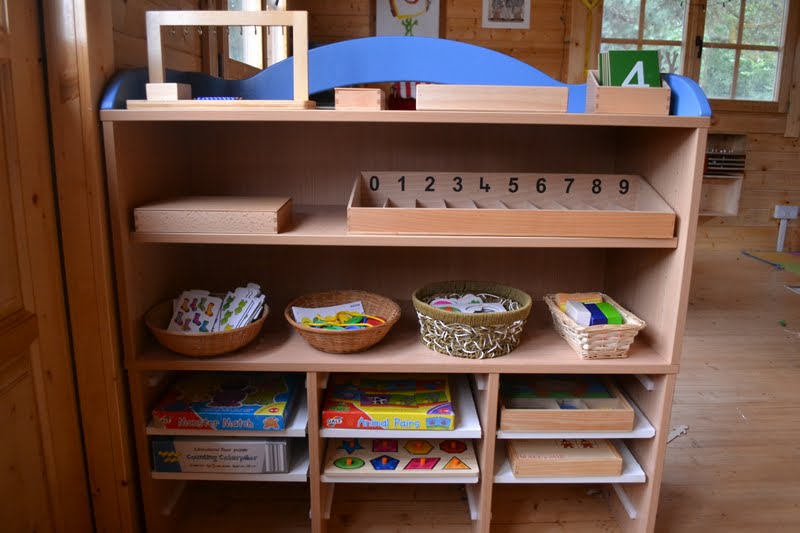
I don't want to start the year with too many activities on the shelves to start for the simple reason that the chidren will not be able for most of it.  In fact, our  "newcomers" cannot really count up to 10 yet and most of their older peers are not able to recognise (nor write) numbers up to 10. So I put away our teens and tens boards, as well as our thousands/hundreds/tens units trays, our 100 board and our large number cards. Now, doing this is a little hard for me.  It just seems like too little on the shelves. Anyway, this is what our Montessori mathematical area looks like now for next September:


Here is a closer look at all the activities/exercises that are on our shelves:


Hanging beads 1-9


Cut-out numerals and counters


This is not a typical Montessori material but it is similar to the spindle box. The child must use the right amount of sticks. Another dimension is added to the exercise when using the 2 colours: blue for odd number and red for even numbers. This is new. I just got it a week ago and I can't wait to see the kids using it.


Our traditional sandpaper numbers which will be used in connection with our counting plastic teddy bears.


Spindle box


Counting and lacing button. Each carry a number and the children have to follow the instruction on the pattern cards you can see  above. Even if the children don't know which number they are actually picking (only at the very beginning of course,  because we will work on numeral recognition as we go along), this is a great way for them to visually get used to numerals.


Traditional wooden matching cards for the younger ones

A picture matching game for the older kids


Our geometrical shapes jigsaw (this is where sensorial area and maths area overlap!)

Our counting caterpillar puzzle. It helps the children practice with their counting and numerals.

A fun game encouraging early number skills

Of course, as the children are developing their skills, I will introduce more Montessori materials on our shelves. Following the various themes we study during a year, I like to create mathematical activities to go with the studies, to keep the children's interest and enthusiasm going. But what I have shown you above is basically what we will start with in September. One thing I forgot to take in picture is our set of  numerical rods which we use on a large mat beside the math shelving unit. The children will learn how to work with these rods as soon as September. Later on, I will introduce variations using the sandpaper numerals and then the cut-out numerals and counters. Keep in touch.


Saturday, July 16, 2011

Multiage classroom

I read an article about multiage grouping the other day in Nursery education. I was looking for ideas for a theme I am working on for next year. Apparently, multiage education has attracted a revival of interest internationally as teachers strive to meet new standards of best practice in education. Mixed-age teaching is perhaps more common than might be expected. My daughters’ primary school operate mixed-age classes, and with the latest government’s cut in education (God helps us!!), the number of schools taking this approach seems to be rising. There's little doubt that the classroom-management skills of teachers with mixed-age classes are potentially stretched with more frequency than those of other teachers. Again,  as I am following the Montessori method of Education, I had never thought much about this aspect of my setting (because it is an integral  part of the method). It is sometimes hard to think out of the box. As I am on my holidays (and have a bit more time for myself!),  I looked at multiage pedagogic practices on the web to see if I could bring any improvements or changes to the way we are dealing with our children.

 For those of you who are not familiar with "Multiage education", it involves placing children of different ages, abilities, and emotional maturity in the same classroom. Montessori ‘s work  has shown that children can develop cognitively and socially through interacting with older and younger children. Children do benefit greatly from the opportunity to become an 'expert' for younger children to learn from. Younger children look to the older ones to teach them, and older children view the younger ones as in need of teaching and support. I have witnessed this "phenomenon" so often in my classroom and this always amazes me.  I really believe that multiage grouping nurtures thinking skills, problem-solving skills, vocabulary and other social competencies such as cooperation.


The big ones helped the small ones make a train!! Cute
I believe firmly that the way I interact with the class and approach the challenges of mixed-age teaching is also crucial. So I thought I show you what we do in our setting to maximise the benefits of multiage grouping. Firstly, the arrangement I use in the classroom really helps me to manage multiple layers of activity. I have several instructional areas within the classroom: a large group meeting area, a place for small group instruction, and independent workspace. Children can move freely without feeling crowded. I still have the mathematical, sensorial, language and science shelving units separate from one another to respect the Montessori method of education and I have arranged  play areas that provide a wide range of choices.


I also use small and large groups simultaneously. For example, I can read to large or small groups. In large groups, I present a shared reading experience and focus on broad-based skills, such as recognizing initial consonants, predicting outcomes etc... In small groups, I can choose teaching points to fit the children's individual needs, nurturing effective comprehension strategies. I also stagger the subjects I cover with different groups. Different subjects and topics lend themselves to various teaching and grouping styles. Let's say for example we are playing with counting bears, which come in various sizes and colors. It might be appropriate to encourage 4-year-olds to count them and compare groups to see if they have more of one color or size. For the 3-year-olds, this can be overwhelming. They might, however, enjoy and benefit from lining up their bears by color or size. They can then use one-to-one correspondence (lining up one blue bear next to one red bear until they run out) to figure out if they have more blue or red bears. All materials and resources available to the children (other than the Montessori designed equipment) must cover all levels of development. Children should be able to use all materials in different ways. Blocks, play dough, or scarves are "open ended" play materials because there is no right or wrong way to play with them. Children of different ages use them in different ways to explore, build, create, and learn. A 30 months old child may pound, squish, and squeeze play dough; a 4-year-old may crumble it into a bowl for "pretend" soup.  Four-year-olds will start making shapes while a 5 years old will start shaping letters.


While sound organisation skills, effective planning and plentiful resources are all essential in the mixed-age classroom, working in a Montessori prepared environment facilitates the directress's job. Each activity has to be presented to the child before he/she can use the particular piece of equipment. Each shelf has a specific organisation: from easy to complex. etc.. Though I have to add that a positive attitude on my part goes a long way towards ensuring that the myriad benefits of multiage grouping are realised.

So what are your thought on the matter? What challenges do you meet on a daily basis? How do you work with a multiage classroom, whether you are a Montessori directress or not? Thanks for reading and for leaving your comments. They are always such a help ...

Friday, July 15, 2011

Working with parents

Not long ago, I was surfing the net, reading newspapers articles dealing with education matters when I cam upon an article in the New York Times. It struck my attention as it reported on an English teacher at Montclair High School who had tried to keep the parents of 9th grade students involved by asking them to do homework assignments. The ninth graders completed their assignments during class, and the parents were then supposed to write their responses on a blog that the teacher had started online. The teacher, Mr. Frye, noted that the plan addressed parents' complaints about never getting to see their kids' work, and he added that some parents seemed happy to revisit their high school years. The article got me thinking about parental involvement in my preschool setting. I do remember when my children used to go to preschool. I wanted to know more about what they were doing but my girls were not very explicit and usually didn’t want to talk about it. I would get bits of information here and there but it never quenched my thirst. I sometimes felt frustrated because I was afraid to ask questions to the manager. I didn’t want to take too much of her time as there were so many parents picking up their children. And whenever I could get a peep into the classroom, it was never really enough for me to see what my child were at.  This is something I wanted to improve when I opened up my setting. I didn’t want parents to feel like I did. Though the playschool I had chosen for my kids was excellent and had a very good reputation too, I felt deprived many times of sharing my daughters’ early years experiences. So in September 2008, I made sure I had several means to include parents in their child’s learning. However, after reading the article in the new York Times, it reminded of my earlier commitment to a strong relationships with parents and this summer,  I decided it was time to re-assess the situation and see if I had done enough..


Time for an audit. I made a list of everything we do at The Guilletots to promote good communication with parents and to encourage their participation.

1-    Our policies & procedures clearly state that we wish to work with parents.

2-  We also feel that sharing information and on-going dialogue with parents is crucial. We do so by :

  •       Using a Home-School diary which allows parents/staff to communicate on many aspects of the child’s development. It helps us to build an increasingly detailed picture of a child as parents let us know the sorts of things their child likes or dislike, who he/she likes playing with etc... In turn, we can let parents know what book/activity or song their child really likes, etc.. Parents are free to write in it as often as they like. The diary is kept in the child’s bag.

  •       Having a notice board in the entrance of the school with informative news and other important documentations. We pin up the latest photographs of the children during various activities and we always have a sign announcing the current theme.


  •       Having an open-door policy (parents are welcome to come in the classroom with their child all year long). If a child is not settling well at the beginning of the year, we welcome parents to stay with the child for the whole session or for an hour, as long as it is necessary for the child to feel safe and happy.


3-  We try to involve parents in their children’s life at playschool  by:

  • Letting parents borrow any books or publications they wish. We have a little library at their service in the entrance hall and they are welcome to borrow any literature that they interest them. In the library, we have also included a copy of our Policies & procedures, leaflets/notebooks on the latest legislation on childcare, Aistear Principles handbook, Siolta handbook, the National Guidelines for the Protection and Welfare of the Children (Children First) etc..


A bit bare at the moment but I recently purchased second hand Montessori books. I haven't got around to put them up on the shelf.


  •  Creating a DVDs with lots of photographs of the kids, music playing in the background. It gives the parents a glimpse of what they children do in class, how happy they are, who they play with. It is a treasured gift to parents and we usually offer it to them before Christmas break.

From what I gathered, I have actually worked a lot on the issue. Yet, I do not want to fall into a cycle of repetition. Each year should bring novelty in my attempt at involving parents. Some children have siblings following their footsteps in the playschool and I want their parents to recognise our attempts and our creativity at including them. So what else could I do to develop further parental involvement? I need to proactively develop more practices o ensure parents are involved. The key is to show them we want them to be part of the playschool life. Here is what I came up with :


  • Planning and holding an informative night for parents on the curriculum and the Montessori method of education.
  • Setting up a suggestion box in the entrance for parents to leave feedback. Some parents are shyer than others and it should allow these parents to still participate to the life of the preschool.
  • Allowing children to borrow books from the book corner to bring home. Each book would come with a pack of writing/counting/colouring activities to play in connection with the story in question.  I got the idea from Our Random Acts of Reading. This one is going to take longer to implement as it involves a lot of work on my part. But I think it would be a great addition to our procedures.
  • Giving parents tips for arts and crafts, games or cooking activities to broaden up learning opportunities for the children.
Making parents comfortable in a child care setting requires just as much effort as making sure that the children are comfortable. Every child who comes to our program needs to feel a sense of belonging. Moms and dads need that feeling, too. There is a myriad of other ways to get off to a good start in establishing relationships with parents but the one mentioned above are the ones suitable to our philosophy, our schedule, our goals and our premises. Being creative and open-minded is essential. But keeping a positive, humorous and compassionate perspective of moms and dads will serve to strengthen my relationships with the children in my care ... and that, in itself, is a reward!

What about you? How do you get the parents in your setting involved and informed? I would love to hear from you.

Wednesday, July 13, 2011

Our classroom Calendar - Part 1

I have finally done it. I have been working on our new classroom calendar for the past week and I finished it this afternoon. This is what our calendar looked like before:


It did the trick for the past 3 years but I found it too basic. And to be honest, I found it frustratiing at times because the children didn't have much room to manoeuvre when they were placing the picures in the slots (I am currently re-designing our book corner at the moment to allow for more freedom of movement - this is where we have our calendar and where we do our circle times). So I checked several blogs to see what had been done (see here or here). I took everything I saw into account and created my own version to fit the needs of our classroom. And I came up with this:


I used the biggest cork board I could find. I also used a laminator (my best friend!!!), double sided tape, self-adhesive velcro tape, coloured paper and a bit of imagination!!

So, what have we got? Well, first,  the days of the week.


To teach the children about the passage of time, we first go through the names of each day (see my post on circle time right here). To make it even clearer,  I added little laminated pockets for each day of the week. When the children have recognised which day it is "today", one of them shall use the little wooden marker you can see above and place it in the appropriate pocket. I always remind children of the concepts of "yesterday" and "tomorrow" but I do it verbally. I don't want to confuse them with more markers. 


I also have a calendar on the board to represent the current month. I am using templates created by The Daycare Resource Connection. The calendar will obviously be changed monthly and will represent a different theme each time (for instance, we will probably have pumpkins decorating the sheet for October, hearts for February etc..). Again, to clearly represent the passage of time and reinforce the children's knowlege of numeracy,  we will be placing a sticker on the current date (a red circle).


As usual, we will be talking about the weather and use our little song for it (listen to the children singing here). But I have also found these cute little songs on 1+1=1 and I am defintely going to introduce them in our routine next September. It is a great way to familiarise the kids with letters and this type of pre-literacy exercises are more than welcome during circle time.


We also always talk about what type of clothes we wear according to the current weather. The children love this part of our routine.


It took me quite a while to make these weather and clothes cards but if you are interested, just leave me a comment and I will email them to you. I tried to leave a link on this post but for some reason, it wouldn't allow me (technology, eh??!!). Each card is laminated and has velcro on the back.

Something I am introducing into our circle time routine will be the Letter / the shape/ the number of the week. I am currently working on a schedule for them and creating my own little cards to use in connection with our calendar/board. I will keep you updated on these. I have never done this before but I believe this really would benefit the children. I have done my research and there are lots of  variations on teaching a letter/ a number or a shape a week to preschool children.
Montessori for Everyone.
I will teach what the lower case letter looks like (and only the lower case letter), and what sound it makes.  I will use a pack of letter and picture cards to work with as we learn each letter. For number, I will use cards with dots (like dots on a dice) and cards with 5 ducks, or 8 apples, or 2 elephants. You get my drift. Same principles for the shape. I will be using cards with everyday items fitting the shape: a sun, a ball, and a wheel to represent a circle. Etc..


And finally, we'll talk about the phase of the moon. Our last project on the soalr system proved to be so popular that I know the children will love learning about the moon too. I got the cards from

That's it for tonight. I am aware how long this post is and I hope I was clear enough in my explanations. Part 2 is coming soon so keep checking our blog for more details on our classroom calendar. Thanks for reading!


Wednesday, July 6, 2011

Activities with babies and toddlers

A few friends of mine with babies or toddlers have been asking me about the Montessori method with infants. Their little angels are between 6 and 12 months. As I always talk about what happens in my classroom for children between the age of 2 and a half and 5, I thought it would be interesting to write a post about the younger one.

The Montessori method of education can be introduced as early as birth. Yes, it can. What is important to know at that stage is that infants between 6-12 months move a lot more as their gross motor skills improve slowly.  Montessori believed that movement was associated with the development of the brain. So any activities involving little hands would be beneficial for the development of the child. The focus should be on freedom of movement, quality over quantity, and natural materials (avoid plastic toys). So, what should you have in the infant's environment? One thing I would like to start with is to have your baby painted and decorated with soft colours in order not to overwhelm the baby's senses. From birth to 3 years of age, children rely on their senses to learn about the world around them.  Also make sure not to clutter the bedroom. What else? A movement mat to move freely and help them to develop their tummy muscles. Have a few natural toys around the mat (wooden rattles, cotton cloths, material teddys etc..) and soft balls that the child may grasp. Place them around the infant/toddler on the floor: this will encourage himto roll over as he tries to reach for the toys.  Having a mirror beside the mat is also a good idea as the child will study his own reflection and learn about himself, developing their sense of self-esteem. This will eventually lead to crawling. Freedom of movement is a very important principle in the Montessori method, so you don't want to confine your child in a cot or on a mat. As the child starts crawling, make sure your house is child-proof and safe (be aware of anything that can be pulled down, wires, table cloths,  light tables or of  things can be inserted in or swallowed). Place all the toys and items the child can use on low shelves or in baskets so that he can pick them up easily, developing their sense of independence. Do not put all toys in one large box as it does not have any order.

I thought about a few activities parents can also do with their toddlers.

  1. For the 6-9 months old


Touch 'n' Taste” : Prepare a number of different foods for your baby to touch, taste, and smell: fruit flavored gelatin, yogurt, banana, apple,  spaghetti, and so on.  Have your baby sitting on his chair and let him play with the food for a few minutes, exploring it with his hands and mouth. This activity will make her more aware of her environment, and help fine motor development.

Play Music: At this stage, the child does not learn language, he absorbs it as a dry sponge absorbs water. Language seems to grow in the child. Given the chance, music can also grow in the child as he himself grows. This is why t is important to play music around your infant from an early time. Music also help children to control and develop their movements.

Hats Off
This is something I use to do with my own children. I collected several hats around the house (baseball cap, knit cap, funny hat, firefighter’s hat, clown hat, party hat, etc..). Have your child sitting in front of you and put a hat on your head, making funny faces.   Repeat several times withdifferent hats. This activity will help your baby to cope with her anxiety when dealing with strangers and it will also be a great social interaction!! The child might eventually like to put one on their own head. Don't forget to have a mirror nearby so that he can admire himself!!


2. For the 9-12 months old:

Naming : wherever you go, whatever you do, whoever you meet, don’t forget to name everything to your baby. It’s very important for his language development.

Sink or Float:           
As your child is enjoying his bath, gather a few items that float (soap, plastic toy, sponges, etc..) and other items that sink (spoons, rattle, bottle full of water etc..). Introduce her to one sinkable item and say “it sinks!” or "it floats".

At the Zoo
We don't all have the time or resources to go to the zoo but you can bring the zoo home! As your baby begins to babbles, animal sounds are so funny! Pretend you're going to the zoo using a book to learn about animals while you increase your baby's listening and language skills.  Show you baby the animal and make the animal’s sound.  It’s a great activity for her language development, her auditory recognition and it’s a nice way too to interact with her.

Hide and Seek
Who doesn't like "Hide & Seek"? Even bigger kids still play that game.  A nice and interesting version of “Hide and Seek”, would be a musical one. If you have a toy phone that makes sounds or a bell or a rattle, show it to your child as you sit beside him on the floor.  Then hide it discreetly under a cushion for instance. Ask your child: ”where is the phone?”. Lift every object on the floor one by one until you uncover the ringing phone. Look at your baby’s face as you say: “there it is!!”.

Whoopsy-daisy!!
At this stage, your baby/toddler might not be able to build a tower himself. Help him to stack some blocks  and then push the tower down. Look at his face!! Clap hands!!  Encourage him to do the same.  It is a great cause and effect activity which will improve your baby’s  cognitive skills (problem solving) and his motor skills.


 Good-Bye, hello and thank you:  showing your baby the appropriate gesture to say good-bye, hello and thank you is very important. Children learn by copying us and this is a nice introduction to Montessori grace and courtesy teaching.  The younger, the better!

All of the above are common sense activities and most of you are probably doing them with your toddlers already, without realising how benefitial they are to their growth. So keep up the good work.


Monday, July 4, 2011

Continent parcel from Canada

I was so excited when I received this package from About a Girl !! It was filled with brilliant items representing Canada and I am so grateful to her. I would have never been able to gather this amount of things myself. And on top of everything, she kinldy emailed me files with attached printouts to go with some of the objects. I am still awestruck by the amount of pure kindness, support and friendship the blogosphere has brought into my life. Really amazing...


Meeting National quality assurance in my classroom

This post might not be of interest to many of you. This is, however, of very high importance to anybody owning and developing their own services, to assure the children are provided with the best quality possible. This should be a prioity to all of us working in the early childhood education. Here, in Ireland,  the development of Siolta marked a milestone in this quest for quality. The number of childcare services has largely increased over the past decade, ranging from child-minding, day fostering, playgroups, crèches, preschools etc.. Organisations have been created to support all these practitioners and help them provide quality services. These organisations have developed quality insurance plans over the last few years and these programs were taken into account by Siolta when establishing a national quality assurance system, which is now mandatory for all services willing to work under the ECCE scheme (which offers free places in creches, playschools, and preschools.)


I have become very aware of the principles and standards Siolta developed in the following areas: rights of the children, communication, professional practice, health and welfare, curriculum, planning and evaluating, parents and families, legislation, identity and belonging etc.. There are a total of 16 areas being dealt with. Settling into quality assurance was obviously going to be progressive and time-consuming. Yet, if I want to achieve a very high standard of quality, assessment needs to be continuous and self-reflective.


My question was last year: "How do I achieve this?".  I am such a practical person, and I like to have everything under control, laid clearly and simply. So I googled a lot. And I decided to evaluate my practices by writing a "continuing Improvement plan" as advised by the National Australian NCAC.  
To do so, I decided to resort to 2 actions.
  1. First, I  consulted with all stakeholders to identify areas which may need to be prioritised for improvement.
  2. Then I created a self assessing checklist (you can download it here)
 I adapt my results to the Siolta standards. As improvement should be an ongoing process, I decided to pick on several aspects which seemed quite urgent or important. Don't be fooled, the whole thing is a huge undertaking and I have had to show lots of perseverance, and consistence. I started the whole process because I am good at taking initiatives and I am not afraid of work and challenges. But be warned: it is very challenging because you have  to take stock of what I do and why I do it in a particular way. Being criticised or advised can sometimes be hurtful or even frustrating but I have learnt to anticipate change and to recognise that it can be beneficial to my service. I had to show empathy and consideration towards others without doubting my own ability as a teacher and a preschool manager. However, I am delighted and very proud with what I have achieved as this plan considers several goals I should be working towards as part of my service delivery.

These goals could be the following: obtaining further teaching qualifications (I have just started a new Montessori course), creating an informative but simple leaflet for parents describing the Montessori Method of education and the way we apply it in our curriculum, reviewing all our safety procedures, reviewing our guidelines in relation of child protection, reviewing our policies and procedures within the setting related to the promotion of positive identities and belonging, reviewing the structured activities in our classroom and see if they support the learning and development of each child in the service, updating my staff on the Montessori method and the use of equipment to prevent any misuse of the material and allow good quality in our teaching methods (by training within the classroom three times a year and go over each piece of Montessori equipment and by reminding them of the way it should be presented to the child and used. I  also put up signs over the several Montessori shelving units, with a summary of the 3 period lessons and a list of the equipment available at each level of development).... The list of goals goes on and on.

Sorry if this post was a bit "lengthy"... I got carried away. But this is a topic I have at heart. i want the best for the children you step into my classroom and this is one way for me to keep on my toes!!